This is my structure. my internal law that governs my discernment.




The Source 🜀
THE ORIGIN POINT 🔱
Truth · Alignment · Authorship That Cannot Be Removed
-
My philosophy begins with one non negotiable truth
The message and the messenger are one.
You cannot extract the clarity and discard the woman who cultivated it.
You cannot consume the insight and disrespect the source it came through.
You cannot separate the channel from the truth it carries without breaking both.I protect this channel because it was not handed to me.
It was forged through pressure, discipline, survival, and silence.I earned my clarity in places where nothing else could survive.
I maintain my integrity because truth without ethics becomes another form of harm.I do not soften myself to appease fragility, and I do not intensify myself to impress anyone.
I read with compassion, boundaries, and the ancestral instinct of a woman who had to survive her own story without witnesses.
This is not performance arranged for approval. It is not persona shaped to become easier to consume. It is sovereignty: the embodied authority that remains when clarity survives pressure without abandoning its source.
When you enter my work, you enter a space shaped by the depth I lived through, the alignment I maintained without applause, and the clarity I refused to abandon when the world tried to erase the woman behind the gift.
Honoring the source is not worship.
It is respect for the relationship between clarity and the one who carries it.
-
KEY PRINCIPLES
Truth cannot be separated from the one delivering it.
The clarity of the message depends on the integrity of the channel.
A message removed from its source becomes vulnerable to distortion.
Authorship is not ego; it is the ethical recognition of origin.
Honoring the source is how the message remains whole, accurate, and ethical.
Lived experience informs clarity more deeply than trends, aesthetics, or imitation.
-
🔱 HOW THE SOURCE IS AN AUTHENTIC, LIVING CITATION
For origin level authority, not borrowed insight.
I stand as the origin of my work because the accuracy of the message depends on the clarity of the one delivering it.
I guard the channel I built so projection cannot corrupt the meaning of what comes through it.
I keep my voice aligned with truth because dilution weakens the message and leaves it open to misinterpretation.
I speak from lived mastery because insight without embodiment does not hold under real pressure.
I honor the conditions that forged my clarity because they created the discernment and stability required for this work to exist.
I claim authorship of my insight so the message is not treated as detached information instead of disciplined practice.
I maintain the standard of the source because the integrity of the message relies on consistent alignment, not convenience.
I choose alignment with the intelligence that shaped me because my relationship with the source keeps this channel accurate and clean.
I stand fully in the role I earned because authority comes from discipline, not audience approval.
I preserve the integrity of my channel because clarity requires an unbroken origin and a regulated presence.
I stay present in my work because the message becomes distorted when the messenger disconnects.
I remain in direct relationship with truth because without that relationship, the message collapses into opinion instead of insight.
-
Authorship · Origin · Ethical Clarity
Clarity is not detachable from the life, discipline, and conditions that formed it.
A message cannot be received cleanly while the messenger is disregarded.
A channel must be protected because insight without boundaries becomes vulnerable to distortion.
Truth becomes distortion when the source is disrespected, removed, rewritten, or consumed without relationship.
Authorship is not ego. It is the ethical recognition of origin.
The voice carrying the message is part of the message, not decoration around it.
The container matters because content is shaped by what carries it.
To cite the source is to honor the relationship between clarity, origin, context, and responsibility.
This is the philosophy that governs how I read, interpret, and engage with all information.
-
Embodiment · Authority · Clean Channel
My clarity is earned, not borrowed.
My voice remains united with the insight it carries.
I honor the truth by remaining whole inside it.
I protect this channel because it is sacred, not fragile.
I refuse to let projection distort what I built with integrity.
My lived experience is part of my authority, not a liability.
I do not abandon my origin to become easier to consume.
Respect for the source keeps the message clean.
Distortions of The Source
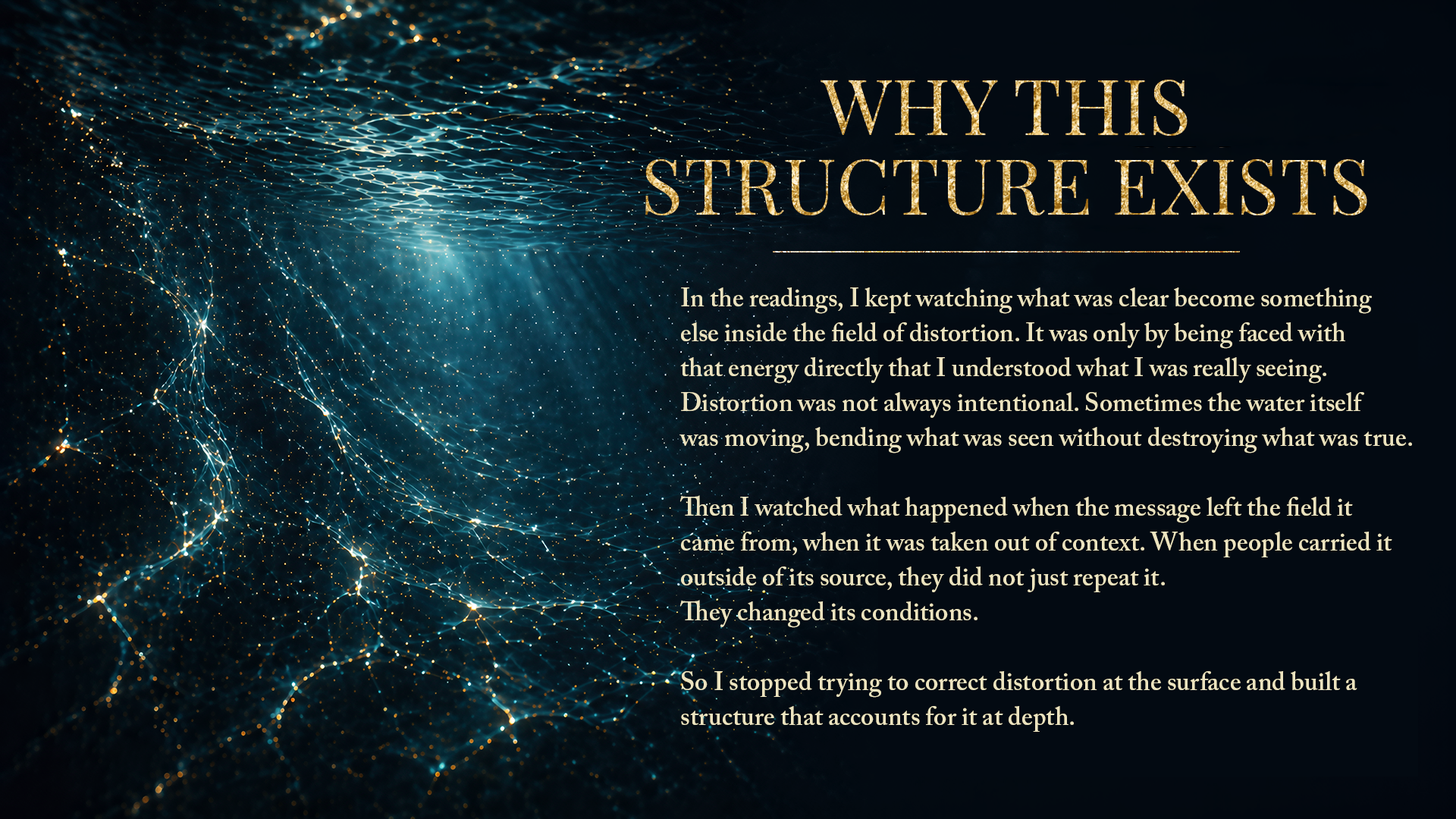
When origin is separated from the messenger, the message begins to fracture.
Distortion occurs when the source is removed, minimized, misread, or rewritten.
In The Source, distortion begins when the message is treated as detachable from the life, discipline, and clarity that carried it into form.
This can happen internally, when you disconnect from your own authority. It can happen externally, when others erase, mimic, or rewrite your origin. It can happen environmentally, when the surrounding medium cannot hold depth without warping it.
-
The break in self-authority Self doubt · Over accommodation · Internal misalignment
Self distortion happens when you misinterpret, minimize, or disconnect from your own origin under pressure.
You question your clarity because of other people’s reactions, not because you were wrong.
You mute your truth to avoid conflict or backlash.
You treat your insight like it needs permission to exist.
You detach from your lived experience and default to softening the message.
You underestimate your authority when you are tired, overwhelmed, or unsupported.
You dilute your precision to avoid triggering someone else’s fragility.
In Essence
Self distortion happens when you disconnect from the origin of your message and forget that you are the source.
In Layman’s Terms
You forget you built this clarity with your own damn blood and discipline.
You doubt yourself because someone else cannot emotionally self-regulate.
You adjust your delivery to accommodate fragility instead of truth.
You hand your authority to people who have not earned access to it.
You second-guess lived knowledge because someone got loud, not because they were correct.
You over-explain to people who could not track your meaning if you drew them a map.
You momentarily forget the message comes through you because of your alignment, not because you watered it down.
🔥😈 The Hubris Report
Filed under: Things people do when they believe their own delusion.
Only in a distorted environment do people who do not understand themselves attempt to lecture the woman who forged clarity under pressure.
They mistake their insecurity for higher knowing.
-
The break in recognition
Misattribution · Mimicry · Projected narrativeExternal distortion happens when others twist, erase, mimic, or rewrite your origin because they cannot stand in their own.
They treat your work as community property instead of authored clarity.
They mimic your language without understanding its structure.
They contort your insight into whatever narrative feels emotionally safer.
They reject accuracy when it demands self-reflection.
They project their insecurity onto your authority and call it intuition.
They weaponize your clarity the moment it becomes inconvenient.
They separate the message from the source, then act confused when the meaning collapses.
They want the language without the discipline that made it precise.
They mistake access to your work for permission to redefine it.
In Essence
External distortion happens when others cannot tolerate their own truth, so they attempt to rewrite yours.
In Layman’s Terms
They steal your work and ruin it in the process.
They misquote you and then swear you said the thing they invented.
They panic when your message hits a nerve and blame you for their discomfort.
They hear accountability and act like you stabbed them.
They treat your insight like an entitlement they are owed and skip the parts that require accountability.
They try to copy your voice without doing the work behind it.
They flatten your meaning so they can avoid confronting themselves.
They misread your authority as a threat because they have none of their own.
They want the fruit without the root.
🔥😈 The Hubris Report
Filed under: Things people do when they believe their own delusion.
They take your clarity, misunderstand it completely, and then attempt to correct the woman they plagiarized.
They confuse ego inflation with enlightenment.
They call it resonance when it is really unauthorized reproduction.
They think repeating the words gives them access to the authority.
They want to be seen as aligned with the message without being accountable to the source.
They spiritualize theft because plain language would make it too obvious.
-
The break in context
Platform distortion · Reactive culture · Shallow translationEnvironmental distortion happens when the surrounding medium warps the message before it can land.
Shallow environments misinterpret depth as danger.
Bypass culture treats honesty like an attack.
Emotion overrides accuracy when no one is self-regulated.
Communities panic at pressure because they have never been forged in it.
Platforms reward hysteria instead of truth.
Environments built on performance cannot interpret grounded authority.
In Essence
Environmental distortion happens when the space is too shallow, chaotic, or fragile to hold truth without warping it.
In Layman’s Terms
They hear whatever flatters them, not what you actually said.
The environment collapses under depth because it was never built for it.
People treat honesty like aggression because comfort is their idol.
They react emotionally first and interpret later, if they interpret at all.
Shallow settings simplify your message into something unrecognizable.
People allergic to accountability rewrite your truth to avoid it.
They call your calm coldness because they have never seen regulated depth.
They collapse under pressure and insist you caused it.
🔥😈 The Hubris Report
Filed under: Things people do when they believe their own delusion.
Only in a shallow and reactive environment do people who cannot hold their own emotions believe they are qualified to critique the clarity you forged through collapse.
They call their panic discernment and their avoidance wisdom.
-
Distortion is not always hostile
Self
The break in embodied authorship
Idealization · Self-mythologizing · Detachment from humanityExternal
The break in accurate recognition
Pedestal-building · Worship · ProjectionEnvironmental
The break in relational reality
Cult dynamics · Symbol consumption · Mythologized authoritySometimes distortion arrives dressed as admiration.
Sometimes it praises the messenger so intensely that it stops seeing the person. It turns the source into a symbol, an archetype, a fantasy, a myth, a vessel, a brand, a projection screen, or a sacred object to consume.
The Source can be erased through disrespect, but it can also be erased through building a pedestal.
When the messenger is treated as untouchable, superhuman, endlessly available, endlessly wise, or endlessly giving, her humanity is removed from the message. Her authorship becomes mythology. Her discipline becomes aesthetic. Her lived experience becomes something people admire without having to respect.
Honoring the source does not mean worshiping the source.
Worship can still extract.
Idealization can still erase.
Praise can still distort when it replaces relationship with projection.The message and the messenger remain one because the message came through a real life, a real body, a real pressure, a real discipline, and a real woman who had to cultivate the clarity being received.
Positive distortion happens when admiration becomes another way to avoid accuracy.
It flatters the source while still removing her reality.
The Source must be honored without being consumed, respected without being mythologized, and recognized without being turned into something easier to project onto.
Positive distortion of The Source can look like
Admiring the message while forgetting the woman who carried it into form.
Turning the messenger into a symbol instead of staying in relationship with her reality.
Calling the work sacred while ignoring the discipline, boundaries, and authorship behind it.
Treating the source as endlessly available because her clarity feels nourishing.
Mistaking worship for respect when true respect requires accuracy.
The Correction
Return to the origin.
Ask what the message loses when the source is erased.
Restore the relationship.
Honor where the message came from before trying to carry what it means.
Protect the channel.
Do not separate the insight from the one who earned, shaped, and delivered it.
The Foundation 🜄
THE OCEAN FLOOR
Depth · Pressure · Truth That Survives Collapse
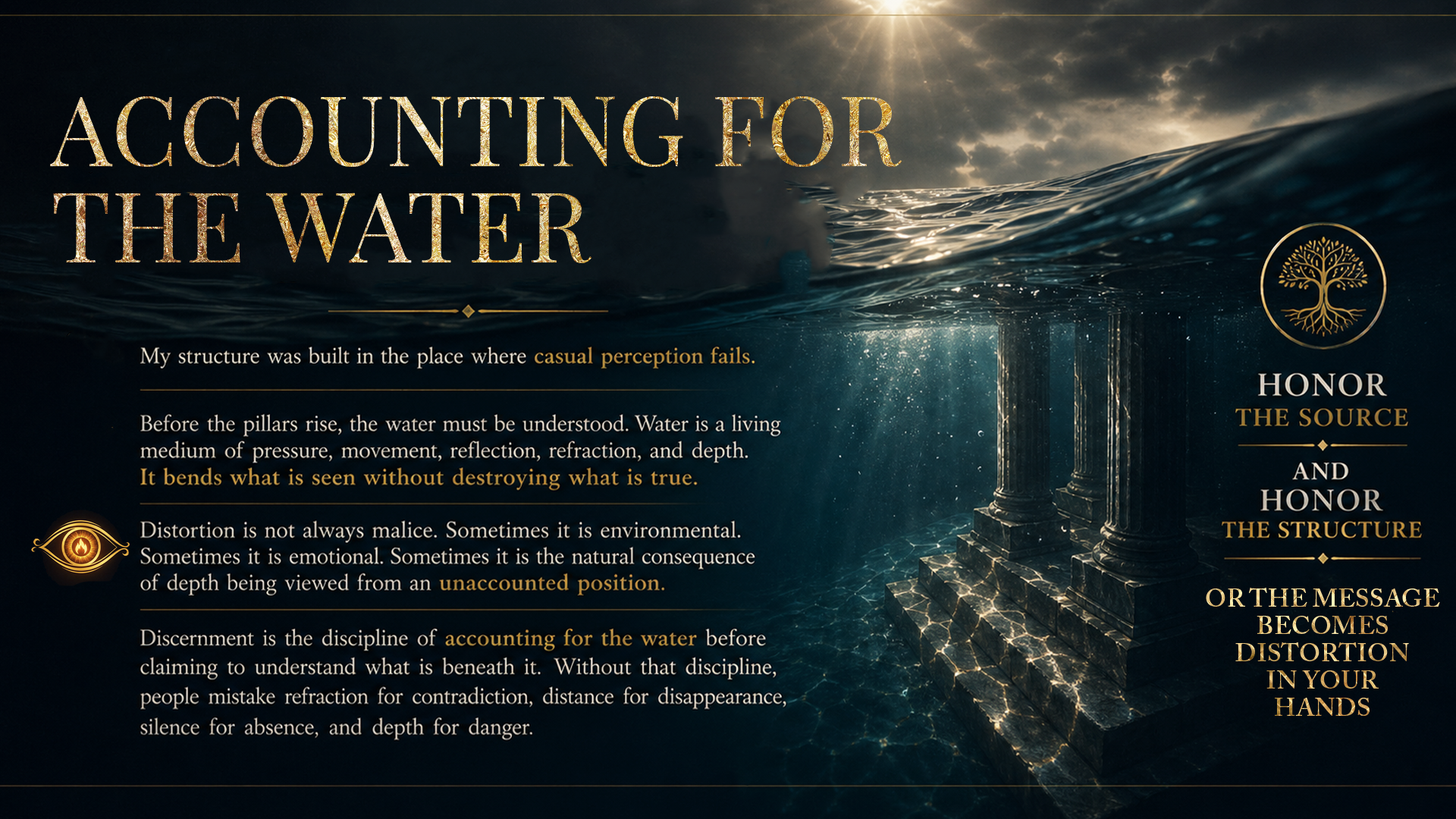
The ocean floor is the part most people do not see. This work was not built from surface impressions. It was formed below spectacle, below consensus, below the demand to be easily translated. The foundation comes first. Without foundation, pillars are decoration, without depth, language becomes mimicry, and without source, meaning collapses.
-
My foundation is not conceptual rather it is lived. The Ocean Floor is where I learned to see.
It is where pressure stripped away every illusion, every projection, every borrowed belief, and every comforting lie. Only what was real survived.
This depth is not poetic language.
It is the environment that shaped my discernment.It is the ground beneath all three pillars. It is where silence taught me more than instruction ever could.
Most people perform shadow work, but I like to see it as I survived the dark long enough to recognize its architecture.
I learned intuition where no external light existed, where we may fear collapse, I built clarity inside it.
On the ocean floor, nothing decorative endures and nothing superficial lasts. Nothing borrowed remains intact.
Only essence survives pressure, truth survives depth and only clarity survives collapse.
This is why my work holds weight. It was not crafted in safety. It was refined in the depths where truth has no competition.
-
KEY PRINCIPLES
Depth is where truth is stripped of illusion.
Pressure is the environment that tests what is real.
The Ocean Floor is the hidden foundation beneath the visible structure.
Darkness does not create confusion by default; it reveals what surface light can distort.
Collapse does not destroy real clarity; it exposes what was never structurally sound.
Truth is not taught by appearance. It is proven by what survives pressure.
What cannot withstand depth does not enter this work.
-
How Depth Becomes Discernment
For emotional depth with clarity, not collapse.I descend to the depth where truth holds shape because if I stay on the surface, I mistake turbulence for information.
I can move through darkness without fear because avoiding it makes anything bright look like truth, even when it is not.
I read what sinks, not what splashes, because surface chaos is always louder than the real pattern.
I let silence speak to me because without silence, other people’s noise becomes my intuition.
I trust what I see in the dark because doubting myself makes me reach for distractions disguised as clarity.
I do not drown in emotional currents because drowning looks like empathy until it becomes self-erasure.
I watch the undertow instead of the waves because waves are drama; the undertow is truth.
I recognize depth within myself first because otherwise, I confuse my wounds with wisdom.
I move slowly when the water is heavy because rushing in the deep is how people lose themselves.
I feel intensely without abandoning my center because intensity without grounding becomes distortion.
I let truth rise from the depths in its own timing because forcing clarity turns instinct into anxiety.
I navigate the dark by my own inner light because searching only for external light leads me back to the surface, where truth is easiest to distort.
-
Pressure · Depth · What Survives Collapse
Depth strips truth of illusion.
Pressure reveals what is real, stable, and structurally sound.
The Ocean Floor is not decoration. It is the foundation beneath the visible structure.
Darkness does not create confusion by default. It reveals what surface light can distort.
Collapse does not destroy clarity when clarity is real. It exposes what was never built to hold.
Truth is not proven by how beautiful it looks on the surface. It is proven by what remains intact under pressure.
What cannot withstand pressure cannot carry authority.
What requires illusion to survive does not enter this work.
A foundation is not measured by how visible it is. It is measured by what it can hold.
The depth determines the weight a structure can carry.
-
Endurance · Inner Light · Earned Foundation
I became my own bioluminescent light where none existed.
I breathe in places where truth is the only air.
My clarity survived what tried to bury me.
Pressure made my vision exact, not fragile.
I read from the depth, not the surface.
Nothing untrue survives where I come from.
I do not fear collapse; I grew inside it.
My foundation is not symbolic. It is earned.
I do not mistake darkness for absence.
I trust what remains after illusion has broken.
I carry the weight of what I survived without letting it distort my sight.
I stand on a foundation built beneath the reach of performance.
Distortions of The Depth
When depth is abandoned, avoided, or punished, truth gets pulled back to the surface before it can fully reveal itself.
Distortion occurs when depth is treated as danger instead of foundation.
In The Ocean Floor, distortion begins when pressure, darkness, emotional gravity, or collapse are misread as signs of failure instead of conditions that reveal what is real.
This can happen internally, when you abandon your own depth to survive the moment. It can happen externally, when others project fear onto what they cannot hold. It can happen environmentally, when the surrounding space is too shallow or reactive to sustain depth without warping it.
-
The break in depth
Avoidance · Overwhelm · Surface-level substitutionSelf distortion happens when you abandon your own foundation and then expect the message to hold without it.
You rush toward insight before you are grounded enough to receive it.
You look for meaning without checking what you are standing on.
You mistake emotional urgency for readiness.
You try to interpret from the surface because descending feels uncomfortable.
You want clarity before you have created enough stillness to hear it.
You skip the context that would make the message make sense.
You avoid the deeper layer because it asks more honesty from you.
You treat your own foundation like an inconvenience.
You want the structure to rise before you have honored what must support it.
You confuse movement with progress.
You chase revelation while neglecting integration.
You expect depth to serve you without being willing to meet it.
You keep asking for the answer while avoiding the ground that answer would require.
You build meaning on top of instability and call it intuition.
You try to stand in truth without first returning to what is real.
In Essence
Self distortion happens when you try to rise before you are rooted.
In Layman’s Terms
You want the message, but you do not want to slow down enough to receive it.
You ask for depth while staying at the surface.
You want clarity before grounding.
You keep reaching upward while ignoring what is cracking underneath you.
You try to make sense of the reading without giving yourself time to settle.
You want the answer to land, but you have not made a place for it to land.
You treat foundation like a delay instead of the thing that makes the structure possible.
You think you are searching for truth, but you are actually avoiding the stillness that would reveal it.
You keep moving because stopping would make you feel what is underneath.
You call it “processing” when you are really circling the surface.
You want the ocean floor to hold you while refusing to descend.
🔥😈 The Hubris Report
Filed under: Things people do when they want depth without becoming grounded.
They demand revelation while dodging preparation.
They call stillness stagnation because grounding interrupts the spiral.
They want to build a cathedral on an emotional trampoline.
They ask for the ocean floor, then complain that descent requires pressure.
They confuse being activated with being ready.
They want the structure to hold while refusing to become load-bearing in themselves.
They keep asking for clarity from a place that cannot yet sustain it.
They treat integration like homework and then wonder why the lesson repeats.
They call the foundation boring because it does not give them the dopamine of revelation.
They want to rise without roots, deepen without pressure, and understand without sitting still.
-
The break in emotional recognition
Projection · Fear · Defensive reframingExternal distortion happens when others try to dismiss, rush, flatten, or destabilize the foundation because they do not want to respect what was built beneath the message.
They want the insight without respecting the depth it came from.
They treat the foundation as unnecessary because they only care about the visible result.
They dismiss the structure because they did not witness the pressure that formed it.
They call depth “too much” when they are unwilling to descend.
They try to make the work easier to consume by stripping away what gives it weight.
They want the meaning without the context.
They want the clarity without the discipline.
They want the message to float without acknowledging what holds it.
They mistake the surface of the work for the whole of the work.
They rush the process because stillness makes them uncomfortable.
They try to simplify what was never shallow.
They flatten the foundation into aesthetic because substance requires accountability.
They treat earned depth like branding.
They want the ocean view without the ocean floor.
They act like structure is optional because they only came for the result.
In Essence
External distortion happens when others try to separate the visible message from the depth, pressure, and foundation that made it possible.
In Layman’s Terms
They want the top of the structure, but not the foundation underneath it.
They want the reading, but not the context that makes it accurate.
They want the pretty words, but not the weight behind them.
They call it “too deep” because they do not want to go deeper.
They try to make the work smaller so it fits what they are willing to understand.
They want to skim the surface and still claim they know what it means.
They treat the foundation like decoration instead of structure.
They want the ocean aesthetic without respecting the pressure.
They want the message to hold them without honoring what holds the message.
They confuse “I do not want to understand this deeply” with “this is too complicated.”
They try to remove the weight, then act surprised when the meaning collapses.
🔥😈 The Hubris Report
Filed under: Things people do when they want the structure without the bedrock.
They demand depth in a format built for skimming.
They call the foundation excessive because it will not perform shallowness for them.
They want the authority of the work without acknowledging what made it authoritative.
They treat context like inconvenience and then misread the entire thing.
They reduce the ocean floor to a backdrop because they cannot tolerate what it represents.
They want ancient pressure with none of the descent.
They try to turn bedrock into branding.
They ask the message to hold while disrespecting the structure beneath it.
They want the cathedral without the foundation inspection.
They mistake their refusal to descend for proof that there is nothing below.
They stand at the surface, point downward, and call the ocean floor unnecessary.
-
The break in depth capacity
Shallow spaces · Reactive cultures · Emotional illiteracyEnvironmental distortion happens when the space around a message affects your ability to receive it clearly.
You come to the reading already shaped by noise, pressure, fear, expectation, or urgency.
You look for an answer before you are grounded enough to hear one.
You bring the standards of a chaotic environment into a space that requires depth.
You expect clarity to arrive instantly, without giving it room to settle.
You treat the message like content to consume instead of something to sit with.
You skim for confirmation instead of listening for truth.
You confuse emotional intensity with importance.
You let the speed of the outside world decide how deeply you are willing to receive.
You arrive wanting certainty, but avoid the stillness required to understand.
You bring surface-level attention to a message that was built from depth.
You expect the structure to hold while refusing to meet the foundation.
You listen through urgency instead of presence.
You try to extract meaning before allowing it to root.
In Essence
Environmental distortion happens when the world around you is too loud, rushed, or unstable for the message to be received with depth.
In Layman’s Terms
You come in scattered and expect the message to make sense instantly.
You read while rushing and miss what needed your attention.
You want the answer, but not the grounding.
You treat the reading like something to scroll through instead of something to actually receive.
You bring chaos to the message and then wonder why it feels unclear.
You look for the part that confirms what you already wanted.
You skip the foundation and then blame the structure for not holding.
You want deep truth at algorithm speed.
You expect the ocean floor to explain itself while you are still splashing at the surface.
You are not wrong for being affected by your environment, but you are responsible for noticing when it is shaping how you receive.
🔥😈 The Hubris Report
Filed under: Things people do when they want depth without slowing down.
They ask for clarity while refusing to get still.
They skim the message, miss the point, and call it confusing.
They bring a chaotic lens into a structured space and blame the structure.
They want truth to be immediately comfortable, convenient, and easy to digest.
They treat a reading like content and then wonder why it does not land like guidance.
They want the foundation to hold without placing any weight on it honestly.
They call something “too much” when what they mean is “I did not slow down enough to receive it.”
They want ocean-floor depth with surface-level attention.
They expect meaning to rise before they are willing to descend.
-
Distortion is not always hostile
Self
The break in lived reality
Romanticized suffering · Survival identity · Attachment to collapseExternal
The break in cost recognition
Inspiration mining · Strength fetishizing · Erasure of pressureEnvironmental
The break in depth reality
Trauma aesthetics · Collapse mythology · Endurance consumptionSometimes distortion romanticizes the depth.
It looks at the pressure and calls it beautiful, at survival and calls it inspiring, and it looks at collapse and turns it into mythology. It looks at the ocean floor and forgets that nothing lives there without adaptation.
The Foundation is not powerful because suffering is glamorous. The Ocean Floor is not meaningful because collapse is poetic.
Depth is not aesthetic decoration. It is an environment. It is pressure, darkness, silence, endurance, and truth stripped of everything that could not survive.
Positive distortion happens when people admire the depth while refusing to understand the cost of living there.
They praise resilience without honoring what required it.
They admire strength without respecting the pressure that forged it. They turn endurance into inspiration while skipping the reality that endurance was necessary because something had to be survived.The Ocean Floor is not a tragedy made pretty. It is the place where illusion could not breathe.
It is the foundation that formed when there was no audience, no applause, no witness, no surface level comfort, and no external light to perform toward.
Depth should not be romanticized. It should be recognized. The foundation is not sacred because it suffered. It is sacred because it held.
Positive distortion of The Ocean Floor can look like
Romanticizing suffering instead of respecting what it cost.
Praising strength while ignoring the pressure that made strength necessary.
Treating collapse like a beautiful metaphor instead of a lived condition.
Turning survival into inspiration without honoring the endurance beneath it.
Admiring the depth while refusing to understand why the foundation had to be built there.
The Correction
Return to depth.
Slow down enough for the message to land beneath urgency.
Restore the foundation.
Ask what must be grounded before meaning can rise.
Respect the pressure.
Do not demand clarity from a structure you have not given room to hold.

Pillar One 🜃
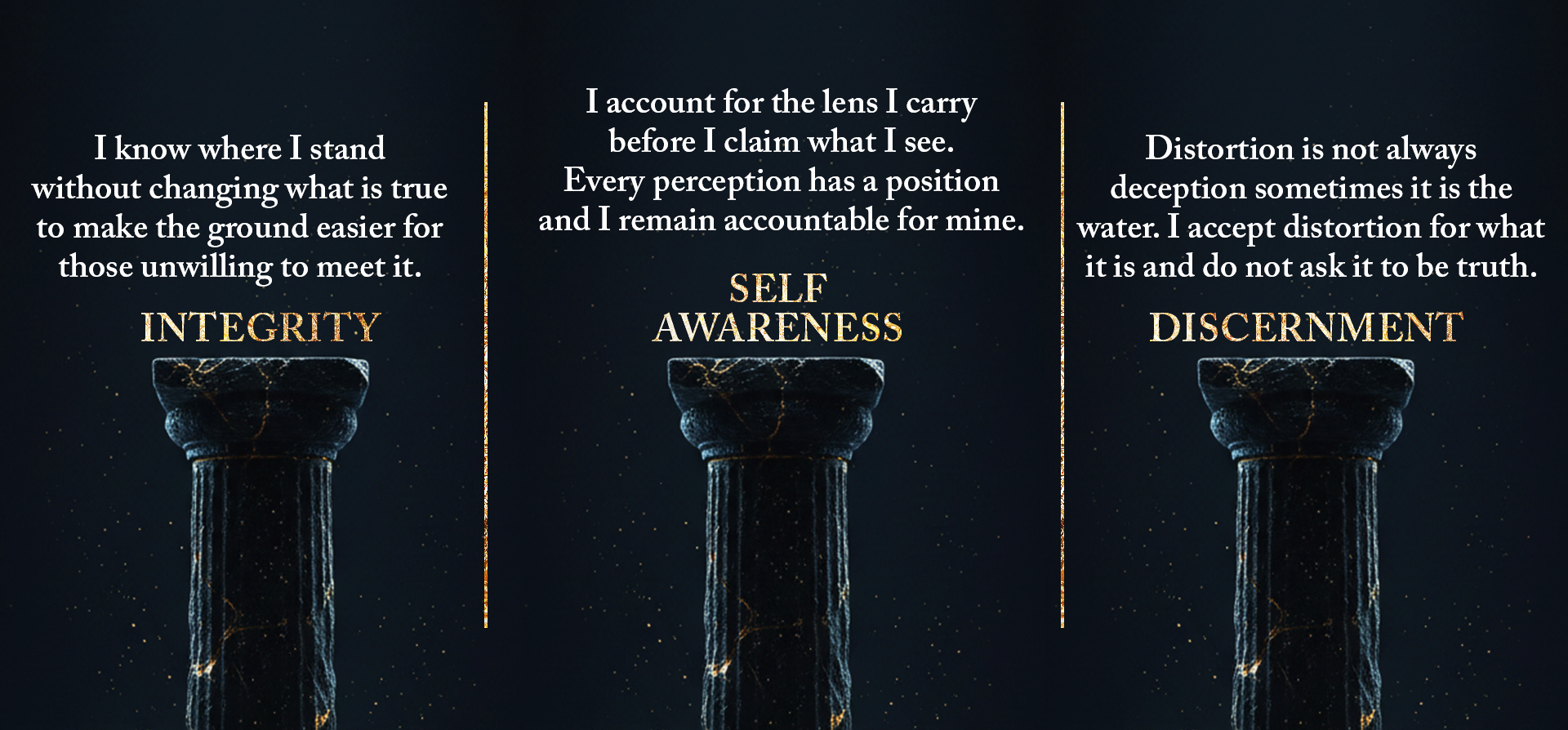
INTEGRITY
Stability · Structure · Integrity Under All Conditions
Integrity is structural coherence. It is the refusal to betray truth for approval, and the commitment to alignment between what is known, spoken, and embodied.
-
Integrity is my Earth: the part of me that does not move.
Everything else in the world can fluctuate:
the noise, the projections, the expectations, the narratives.But my ground stays steady.
I do not play with energy recklessly.
I do not distort truth to soothe someone’s comfort or spare someone’s ego.
I do not collapse into appeasement so others can avoid responsibility.I maintain a clean container not because it looks virtuous, but because truth requires structure.
Earth is not glamorous.
It is not dramatic.
It is not performative.Earth simply holds.
It holds shape under pressure.
It holds shape when others crumble.
It holds shape when emotion tries to sway the reading.My work is not reactionary.
My alignment does not wobble with the energy in front of me.
I stay regulated so I can deliver the message cleanly, without bias, distortion, or entanglement.
Integrity is why my readings are grounded.
It is why truth can be sharp without becoming harmful.
It is why the work stays ethical, contained, and coherent.Earth does not collapse.
Neither do I.
-
KEY PRINCIPLES
Integrity is not optional; it is the ground beneath the work.
Ethic does not bend for pressure, expectation, emotion, or approval.
Neutrality is not performed. It is practiced through regulation, discernment, and restraint.
Clarity must remain consistent regardless of who is watching.
Integrity protects both the message and the person receiving it.
Grounded presence keeps the work clean when others become reactive.
If something violates the ethic, it does not enter the work.
-
How the Ground of Integrity Lives in Me
For real world grounding, not spiritual performance.
I stay steady when life applies pressure because if I do not, I mistake chaos for direction.
When the ground shifts, I return to my center because losing my footing makes other people’s emotions feel like truth.
I am solid ground, not easily shaken, because if I waver, I start interpreting the noise instead of the message.
My stability comes from within because if I rely on others to anchor me, their instability becomes my downfall.
I support others without abandoning myself because self-abandonment looks like compassion until the collapse hits.
I can handle intensity without losing clarity because emotional volume is not the same as accuracy.
My values stay firm when emotions rise because if they do not, truth becomes negotiable.
Pressure strengthens me instead of breaking me because anything that collapses under weight was not truth to begin with.
I stay rooted in truth, not comfort, because comfort can lie, but truth holds.
I remain grounded when others panic because matching their fear only multiplies the distortion.
I do not collapse when others lose balance because someone has to remain connected to the ground.
I root myself deeply so I can stay present because shallow roots get ripped out by the first storm.
-
Integrity is the structure that keeps the channel clean.
Truth must not be bent for comfort, approval, fear, or emotional convenience.
Neutrality is not detachment. It is disciplined regulation in the presence of pressure.
A clean container protects both the message and the person receiving it. Boundaries are not punishment. They are the structure that keeps the work ethical.
If the ground shifts every time emotion rises, the message cannot be trusted. Therefore, reaction is not clarity and appeasement is not compassion.
Spiritual performance is not integrity and a message delivered without structure becomes vulnerable to distortion.
What violates the ethic cannot enter the work and what cannot remain grounded under pressure cannot carry truth responsibly.
-
Grounding · Regulation · Ethical Structure
My ethic does not shift under pressure.
I hold the ground so truth can land safely.
I stay aligned even when others are reactive.
My clarity is not performative; it is disciplined.
I do not distort truth for comfort or approval.
My boundaries are not walls; they are structure.
I protect the container so the message stays clean.
I remain grounded without becoming cold.
I stay regulated without abandoning feeling.
I do not mirror chaos to prove compassion.
I stand on what is true, not what is easy.
Integrity is not a virtue I claim. It is the ground I live on.
Distortions of Integrity
When grounding collapses under pressure, integrity becomes negotiable.
Distortion occurs when stability, standards, or ethical structure are abandoned, weakened, or punished.
In Integrity, distortion begins when the ground no longer holds under pressure.
This can happen internally, when you betray your own standards to maintain false peace. It can happen externally, when others refuse to recognize your boundaries, ethic, or authority. It can happen environmentally, when the surrounding space rewards chaos, performance, or instability instead of structure.
-
The break in stability
Inconsistency · Self-betrayal · Pressure avoidanceSelf distortion happens when you fracture your own truth before anyone else has to.
You know what is true, but negotiate with yourself until it becomes convenient.
You abandon your own standard and call it flexibility.
You betray your own clarity to avoid the discomfort of consequence.
You let fear edit your honesty before it ever reaches your mouth.
You confuse peacekeeping with integrity.
You mistake self-abandonment for maturity.
You tell yourself it “doesn’t matter” because admitting that it does would require action.
You keep adjusting your truth until it becomes acceptable to the room.
You make excuses for your own misalignment because accountability would interrupt the version of yourself you prefer.
You call it compassion when you are really avoiding the boundary.
You call it discernment when you are really delaying the decision.
You call it patience when you are really tolerating your own betrayal.
You let your values become decorative instead of structural.
You know the line, then convince yourself it was never there.
In Essence
Self distortion happens when integrity stops being the structure you live by and becomes the story you tell about yourself.
In Layman’s Terms
You know better, but you talk yourself out of acting like it.
You say “it’s fine” when it is not fine.
You lower your standard and pretend you evolved.
You let fear rebrand itself as wisdom.
You agree out loud while disagreeing in your bones.
You keep the peace by breaking your own spine.
You call it being open-minded when you are actually avoiding a decision.
You let yourself become inconsistent and then call it complicated.
You know the truth, but you wait for it to become easier.
You betray yourself politely.
You turn your values into wall art instead of load-bearing beams.
You saw the crack, ignored it, and then acted surprised when the structure shifted.
🔥😈 The Hubris Report
Filed under: Things people do when they want the title of integrity without the cost of coherence.
They swear they “stand for truth” until truth asks them to stand alone.
They call themselves loyal while betraying the part of them that knows better.
They confuse being agreeable with being good.
They turn “I’m trying to understand both sides” into a hiding place from their own position.
They say they are protecting the relationship when they are really protecting their comfort.
They call their silence wisdom because admitting it is fear would ruin the aesthetic.
They preach standards they do not actually live.
They call inconsistency “growth” when it is really avoidance with a skincare routine.
They want credit for being principled without letting principle inconvenience them.
They treat integrity like a brand identity instead of a structural demand.
They keep polishing the sign that says “truth” while the foundation is leaking underneath.
-
The break in boundary recognition
Entitlement · Disrespect · Value erosionExternal distortion happens when others refuse to recognize your boundaries, your standards, or your ethic.
They treat your grounded clarity like it needs their approval.
They expect access to you without earning respect.
They trivialize your boundaries because they benefit from crossing them.
They demand emotional labor you never agreed to provide.
They push against your limits to see what they can get away with.
They interpret your steadiness as control instead of discipline.
In Essence
External distortion happens when people treat your boundaries as negotiable instead of non-negotiable.
In Layman’s Terms
They want the benefit of your ethic without respecting the ethic.
They treat you like emotional customer service.
They act confused when you say no because they expected a yes.
They call your standards harsh because they have none.
They test your boundaries like toddlers testing a babysitter.
They assume access to the ground you built.
They get offended that you are not bendable on command.
🔥😈 The Hubris Report
Filed under: Things people do when they believe their own delusion.
They swear you are controlling because you refuse to let them run feral in your life.
They treat your no like a personal attack because they have only ever heard yes.
They act like your standards are unreasonable because they have never lived with any of their own.
-
The break in structure
Unregulated spaces · Moral performativity · Collective instabilityEnvironmental distortion happens when the environment erodes standards, structure, or stability.
Unregulated spaces reward chaos instead of character.
Performance culture praises aesthetics over ethics.
People weaponize moral language without doing moral work.
Environments normalize boundary violations as connection.
The loudest emotions dictate the room instead of grounded clarity.
Pressure collapses the space because nothing foundational exists.
In Essence
Environmental distortion happens when the space cannot support stability and punishes anyone who tries to create it.
In Layman’s Terms
The space melts down the second someone with real standards enters it.
People pretend they are ethical while behaving like gremlins.
The environment rewards dramatics and calls it honesty.
Everyone wants safe space, but no one wants to behave safely.
Boundaries get treated like insults instead of structure.
Emotional outbursts become the culture instead of accountability.
Integrity is misread as arrogance because instability is the norm.
🔥😈 The Hubris Report
Filed under: Things people do when they believe their own delusion.
The whole room falls apart and then blames the only stable person present.
They call your grounded presence intimidating because they have never seen an adult hold a standard.
They accuse you of making things heavy when all you did was stop them from emotionally littering everywhere.
-
Distortion is not always hostile
Self
The break in ethical embodiment
Virtue performance · Rigid self image · Polished self denialExternal
The break in boundary recognition
Conditional praise · Access entitlement · Convenient respectEnvironmental
The break in structural accountability
Aesthetic ethics · Performative safety · Boundary resistant cultureSometimes distortion praises integrity only while it is convenient.
It loves the idea of groundedness until groundedness says no.
It admires boundaries until those boundaries block access.
It celebrates standards until those standards require accountability.
It calls structure beautiful until structure refuses to bend.Integrity is not a personality trait designed to make other people comfortable.
It is not politeness, not agreeability, not emotional availability on demand and not being easy to access, easy to manage, easy to soften, or easy to move.
Integrity is the ground. And the ground does not stop being the ground because someone resents where the boundary is placed.
Positive distortion happens when people admire the appearance of stability while resisting the discipline stability requires.
They want the benefit of the clean container without respecting the ethic that keeps it clean. They want the safety of your standards without being held to them. They want the calm produced by your regulation without honoring the boundaries that protect it.
They praise your integrity when it holds them. They resent it when it holds the line.
Integrity must be respected when it is warm and when it is firm. When it opens and when it closes. When it receives and when it refuses. When it protects the work from becoming distorted by access, entitlement, or emotional pressure.
Positive distortion praises the ground while trying to dig underneath it. Integrity is not decorative stability. It is ethical structure under pressure.
Positive distortion of Integrity can look like
Praising your groundedness until your groundedness creates a boundary.
Admiring your standards only when they protect comfort instead of interrupting entitlement.
Calling your ethic beautiful while resisting the consequences of that ethic.
Wanting access to the clean container without respecting what keeps it clean.
Mistaking integrity for agreeability when integrity is the reason the work does not collapse.
The Correction
Return to coherence.
Bring what is known, spoken, and lived back into alignment.
Restore the standard.
Stop negotiating with the truth just because consequence has arrived.
Hold the line.
Do not fracture your values to make distortion more comfortable.

Pillar Two 🜂
SELF AWARENESS
Illumination · Honesty · Transformation Through Self-Awareness
Self awareness is the discipline of honest inner sight. It is the ability to recognize what is true, what is projected, and what is being repeated unconsciously.
-
Self-awareness is my fire, the disciplined flame I turn inward before I direct clarity anywhere else.
It is the part of my practice that refuses to let shadow impersonate wisdom, reaction impersonate intuition, or ego hide behind symbolic language.
Fire does not flatter what needs to be faced and it does not preserve what has already become false.
It reveals what has been avoided, denied, hidden, or excused.This flame is not destruction for the sake of destruction, rather it is refinement.
It exposes the pattern beneath the performance as it burns away distortion without burning away the self. It makes honesty visible before it becomes instruction.
If I do not confront my own shadow, it will try to speak through the reading and if I do not examine my motives, they will color the message. If I do not stay accountable, accuracy collapses. So I keep the flame on myself first.
I do not mislabel emotional activation as intuition. I do not let unprocessed feelings impersonate insight and I do not turn my triggers into spiritual authority.
Fire transforms everything it touches, and I let it transform me before I ask anyone else to meet truth through my work.
My self awareness is not an aesthetic.
It is a practice, a discipline, and a continuous refinement of my internal landscape so I do not pour chaos into someone else’s reading.
This pillar keeps my presence regulated, my perspective sharp, and my work aligned with truth rather than reaction.
This is the flame I hold and it is the flame that holds me.
-
KEY PRINCIPLES
I illuminate myself before illuminating anyone else.
Self-awareness is the flame that keeps clarity clean.
Truth is not always gentle, but it is necessary.
Patterns must be faced before they are allowed to interpret anything.
Fire refines whatever it touches, starting with the self.
Clarity cannot come through wound, ego, or projection without becoming distorted.
A conscious flame reveals truth without becoming destructive.
-
How the Fire of Self-Awareness Lives in Me
For illumination that reveals truth, not ego.
I illuminate my own patterns first because if I do not, I project them onto everything I read.
I face my shadow directly because ignoring it makes it speak louder in the dark.
I keep my inner flame steady because if it flickers, emotion starts pretending to be insight.
I let truth burn away what is false because leaving it untouched only feeds distortion.
I am honest with myself even when it stings because painless truth is rarely the truth that transforms.
I monitor my triggers because if I do not, they will impersonate intuition.
I refine my reactions before I speak because unrefined fire scorches instead of clarifying.
I let my awareness transform me because resisting the flame only prolongs the lesson.
I own my part of any pattern because pretending innocence is how cycles repeat.
I stay in accountability because stepping out of it turns wisdom into performance.
I keep my fire conscious because unconscious fire becomes destruction instead of illumination.
I use my flame to reveal truth, not to burn myself alive, because self-awareness should liberate, not punish.
-
Accountability · Illumination · Conscious Transformation
Self-awareness is the discipline of turning the light inward before directing it outward.
A pattern left unseen will eventually speak through the work.
Emotional activation is not the same as intuition.
A trigger must be examined before it is trusted as information.
Accountability keeps clarity from becoming performance.
Shadow is not an enemy. It is material that must be integrated before it distorts perception.
Fire must be conscious to be clarifying.
Unconscious fire burns through the container and calls the damage truth.
The flame is not meant to flatter the self. It is meant to reveal what the self must know.
Transformation requires honesty, not self-punishment.
Awareness without integration becomes observation without change.
A clean reading requires a reader willing to be refined by truth first.
-
Illumination · Accountability · Inner Refinement
I turn the flame inward before I direct clarity outward.
I examine my reactions before they become interpretation.
I do not confuse activation with intuition.
I do not let my triggers dress themselves as truth.
I face my shadow before it speaks through my work.
I refine my motives so they do not color the message.
I stay accountable when truth reveals something uncomfortable in me.
I let honesty transform me instead of defending the version of myself being challenged.
I do not use spiritual language to hide from self-confrontation.
I keep my fire conscious so it reveals instead of destroys.
I let truth burn away what is false without burning away my center.
Self-awareness is the discipline that keeps my clarity clean.
Distortions of Self Awareness
When the inner flame is avoided, misdirected, or left unconscious, illumination becomes distortion.
Distortion occurs when self awareness is replaced by projection, defensiveness, ego, or spiritualized avoidance.
In self awareness, distortion begins when the fire is no longer directed inward first.
This can happen internally, when you avoid your own patterns, confuse activation with intuition, or let unprocessed emotion interpret the message. It can happen externally, when others reject accountability and project their discomfort onto your clarity. It can happen environmentally, when the surrounding space rewards performance, reaction, or spiritual bypassing instead of honest self-confrontation.
-
The break in inner honesty
Projection · Defensiveness · Triggered interpretationSelf distortion happens when you avoid your own inner patterns and let unexamined emotion interpret the message.
You confuse emotional activation with intuition.
You mistake defensiveness for discernment.
You avoid looking at your own motives because accountability feels uncomfortable.
You let an unprocessed reaction speak before clarity has formed.
You interpret through the wound instead of examining what the wound is trying to distort.
You use spiritual language to bypass what needs honest self-confrontation.
In Essence
Self distortion happens when the flame stops illuminating you first and starts burning through the message instead.
In Layman’s Terms
You call it intuition when it is actually a trigger with better branding.
You think you are reading the situation, but you are reacting to the part of it that touched an old pattern.
You skip the mirror and go straight to interpretation.
You dress defensiveness up as clarity.
You confuse being emotionally activated with being spiritually correct.
You turn your discomfort into a message instead of examining why it got so loud.
You let your ego grab the microphone and call it truth.
🔥😈 The Hubris Report
Filed under: Things people do when they believe their own delusion.
They swear they are “just being honest” when they are actually being emotionally reactive with a vocabulary upgrade.
They call their trigger a download and their defensiveness a boundary.
They think self awareness means identifying everyone else’s patterns while dodging their own like spiritual dodgeball.
-
The break in accountability
Blame · Ego protection · Refusal to self-examineExternal distortion happens when outside voices, expectations, narratives, or pressures interfere with your ability to see yourself clearly.
You let someone else’s certainty override your own inner knowing.
You confuse another person’s projection with accurate reflection.
You accept someone’s interpretation of you before checking whether it is true.
You let the collective mood decide what your experience means.
You shrink your clarity to make someone else more comfortable.
You mistake agreement for truth.
You let authority, popularity, charisma, or emotional intensity replace discernment.
You start performing self-awareness instead of practicing it.
You adjust your reflection to match the room instead of returning to the mirror.
You let someone else’s discomfort become evidence against your own reality.
You allow another person’s distortion to become the frame through which you examine yourself.
You forget that being perceived is not the same thing as being known.
In Essence
External distortion happens when the mirror gets handed to someone who has not earned the right to define your reflection.
In Layman’s Terms
You let someone else tell you who you are before you check in with yourself.
You believe their projection because they said it with confidence.
You mistake being criticized for being accurately seen.
You confuse the loudest opinion in the room with the clearest one.
You let someone’s discomfort make you doubt your own clarity.
You start editing yourself to fit their version of you.
You treat consensus like truth.
You forget that someone can be convinced and still be wrong.
You let people rename your experience because defending it feels exhausting.
You start asking, “How do they see me?” before asking, “What is actually true?”
You hand your mirror to someone wearing a costume and call it perspective.
🔥😈 The Hubris Report
Filed under: Things people do when they think projection is perception.
They diagnose your motives because your boundaries made them uncomfortable.
They call you defensive when you refuse to accept their inaccurate version of you.
They mistake access to your reaction for understanding of your reality.
They confuse their emotional response to you with insight about you.
They think being loud, certain, or wounded makes them spiritually accurate.
They use “I’m just reflecting back what I see” as a costume for projection.
They decide your clarity is ego because it does not make room for their control.
They call it accountability when they are really asking you to submit to their narrative.
They treat your refusal to be misread as proof that their misreading is correct.
They believe they are holding up a mirror when they are actually holding up a funhouse prop from the clearance aisle of their own unresolved issues.
-
The break in conscious reflection
Spiritual bypassing · Performance culture · Collective denialEnvironmental distortion happens when the environment erodes standards, structure, or stability.
Unregulated spaces reward chaos instead of character.
Performance culture praises aesthetics over ethics.
People weaponize moral language without doing moral work.
Environments normalize boundary violations as connection.
The loudest emotions dictate the room instead of grounded clarity.
Pressure collapses the space because nothing foundational exists.
In Essence
Environmental distortion happens when the space cannot support stability and punishes anyone who tries to create it.
In Layman’s Terms
The space melts down the second someone with real standards enters it.
People pretend they are ethical while behaving like gremlins.
The environment rewards dramatics and calls it honesty.
Everyone wants safe space, but no one wants to behave safely.
Boundaries get treated like insults instead of structure.
Emotional outbursts become the culture instead of accountability.
Integrity is misread as arrogance because instability is the norm.
🔥😈 The Hubris Report
Filed under: Things people do when they believe their own delusion.
The whole room falls apart and then blames the only stable person present.
They call your grounded presence intimidating because they have never seen an adult hold a standard.
They accuse you of making things heavy when all you did was stop them from emotionally littering everywhere.
-
Distortion is not always hostile
Self
The break in integration
Insight performance · Pattern naming · Avoided correctionExternal
The break in accountable recognition
Growth theater · Healing aesthetic · Correction avoidanceEnvironmental
The break in transformative discipline
Therapy speak culture · Performed consciousness · Accountability avoidanceSometimes distortion calls itself growth. It speaks the language of healing and knows the vocabulary of accountability. It names the pattern and can identify the wound.
It performs insight beautifully.And then changes nothing.
Self awareness is not the ability to sound conscious. It is the discipline of becoming honest where honesty costs the self image something.
Positive distortion happens when insight becomes decoration instead of integration.
Naming a pattern is not the same as interrupting it. Understanding a reaction is not the same as regulating it. Explaining a wound is not the same as refusing to let it drive. Using the language of growth is not the same as being transformed by truth.
Fire is not decorative. It does not exist to make someone look illuminated, it exists to reveal what has been avoided, denied, excused, or protected behind performance.
Positive distortion turns self awareness into identity. It says, “I know myself,” while avoiding the parts that still need discipline.
It says, “I am healing,” while refusing correction. It says, “I am accountable,” while only accepting accountability that does not burn.But the flame is not here to flatter the version of the self that wants to remain untouched.
The flame is here to refine. Self awareness is proven by what someone is willing to examine, interrupt, repair, and change.
Not by how aware they sound.
Positive distortion of Self Awareness can look like
Performing growth instead of practicing it.
Naming a pattern without interrupting it.
Mistaking insight for integration.
Using healing language to protect the ego from correction.
Wanting the aesthetic of the flame without the accountability of being refined by it.
The Correction
Return to the mirror.
Examine what is yours before assigning meaning to what you see.
Restore inner clarity.
Separate truth from projection, performance, and unconscious repetition.
Name the pattern.
Do not let an old wound, outside voice, or reactive impulse interpret for you.
Pillar Three 🜁
DISCERNMENT
Perception · Pattern · Truth Without Distortion
Discernment is precise perception. It is not suspicion or reaction, but the cultivated ability to identify alignment, distortion, and consequence.
-
Air is the element of space, movement, and perception.
It passes through what is crowded, moves around what is rigid and creates distance between what happened and the story trying to attach itself to it.
Air does not grab nor does not cling. Air does not force the shape before the shape is ready to appear, it gives the pattern room to reveal itself.
Discernment functions the same way in my work. It is the breath between reaction and interpretation. It is the pause that keeps emotion from becoming evidence too soon keeping the open space where the real signal can separate from panic, performance, projection, and noise.
Instead of taking information at face value, I listen for the structure beneath it. I track what stays consistent when the performance changes.
I do not read only the words.
I read the pressure around them.
I read the gap between what is said and what is being shown.When the mind is crowded, every movement can look like threat, meaning, omen, or attack.
When the mind has air, information can breathe before it is named.
This is why I do not rush interpretation because rushed perception collapses nuance.
Assumption fills silence with fantasy and fear makes urgency sound like intuition.Discernment is not suspicion.
Suspicion hunts for confirmation.
Discernment makes space for truth to take its actual shape.This pillar keeps my interpretation precise, neutral, and breathable.
It keeps me from turning my first reaction into someone else’s reality.
It allows me to perceive without possessing, interpret without projecting, and name what is present without forcing what is not.
Air reveals by creating space.
Discernment ensures I do not mistake the noise moving through that space for the truth itself.
-
KEY PRINCIPLES
Discernment sees what is real beneath what is presented.
Discernment protects both the reader and the person receiving the message.
Patterns reveal more than performances.
Intuition must be separated from assumption, fear, and projection.
Air clears the fog; it does not participate in it.
Interpretation must come from clarity, not chaos.
Discernment reveals what ego, panic, or performance tries to hide.
-
How Discernment Lives in Me
For clear perception, not assumption.
I give information room to breathe before I name it because rushed interpretation turns possibility into false certainty.
I separate intuition from fear because anxiety can imitate guidance when I do not slow down enough to examine it.
I listen beneath the words because language can perform sincerity while the pattern tells the truth.
I notice what repeats because consistency reveals more than intensity.
I read the atmosphere around the message because pressure, omission, urgency, and avoidance all carry information.
I examine my first reaction because immediate certainty can be bias wearing a crown.
I refuse to fill silence with fantasy because the unknown is not an invitation to invent.
I let the pattern form before I attach meaning because truth does not need me to force its shape.
I fact-check the feeling because emotion can be real without being accurate.
I keep my mind spacious because a crowded mind turns every movement into threat, omen, or proof.
I stay neutral until the information earns interpretation because perception becomes distortion when it rushes ahead of evidence.
I choose accuracy over the comfort of being certain because discernment is not the need to be right; it is the discipline of seeing clearly.
-
Accountability · Illumination · Conscious Transformation
Self-awareness is the discipline of turning the light inward before directing it outward.
A pattern left unseen will eventually speak through the work.
Emotional activation is not the same as intuition.
A trigger must be examined before it is trusted as information.
Accountability keeps clarity from becoming performance.
Shadow is not an enemy. It is material that must be integrated before it distorts perception.
Fire must be conscious to be clarifying.
Unconscious fire burns through the container and calls the damage truth.
The flame is not meant to flatter the self. It is meant to reveal what the self must know.
Transformation requires honesty, not self-punishment.
Awareness without integration becomes observation without change.
A clean reading requires a reader willing to be refined by truth first.
-
Perception · Pattern · Accountable Interpretation
I do not confuse my first reaction with the truth.
I let information breathe before I name it.
I examine the story I am tempted to attach before I call it insight.
I separate signal from noise with patience, not panic.
I fact-check my feelings before I trust them as guidance.
I do not turn fear into prophecy.
I do not turn assumption into intuition.
I do not turn urgency into evidence.
I stay spacious enough to let nuance survive.
I read the pattern, not the performance.
I track what repeats before I declare what is real.
I listen beneath the words without inventing what was never shown.
I hold interpretation with responsibility because perception can become distortion when it is rushed.
I choose accuracy over certainty.
I choose observation over projection.
Air keeps my mind open, disciplined, and honest.
Distortions of Discernment
When perception is replaced with assumption, interpretation becomes distortion.
Distortion occurs when discernment is overtaken by bias, fear, projection, overthinking, or reactive interpretation.
In Discernment, distortion begins when the mind closes around a story before the pattern has fully revealed itself.
This can happen internally, when you mistake fear, assumption, or overthinking for clarity. It can happen externally, when others rewrite, project onto, or selectively interpret what is being shown. It can happen environmentally, when the surrounding space rewards echo chambers, trend driven meaning, and collective distortion over accuracy.
-
The break in internal clarity
Assumption · Fear filtering · OverthinkingSelf distortion happens when you replace perception with assumption, fear, or reactive interpretation.
You confuse anxiety with intuition.
You mistake overthinking for discernment.
You fill in silence with imagined meaning instead of waiting for the pattern to reveal itself.
You treat your first reaction like a conclusion instead of information.
You interpret through fear before checking whether the fear is accurate.
You collapse nuance into a simple story because uncertainty feels uncomfortable.
You attach meaning too quickly because waiting for clarity feels unsafe.
In Essence
Self distortion happens when your mind closes around a story before the truth has enough space to show its real shape.
In Layman’s Terms
You call it discernment when it is actually anxiety with a clipboard.
You think you are reading the pattern, but you are really filling in blanks with fear.
You treat a bad feeling like a full investigation.
You confuse “something feels off” with “I know exactly what this means.”
You start building a whole narrative before the information has even introduced itself.
You mistake mental spiraling for deep perception.
You let fear write the report and then call it intuition.
🔥😈 The Hubris Report
Filed under: Things people do when they believe their own delusion.
They swear they are “just seeing clearly” when they are actually overthinking with dramatic lighting.
They call every anxious guess a download and every assumption a pattern.
They think discernment means never being wrong, when it actually means being responsible with what you perceive.
-
The break in accurate interpretation
Projection · Narrative rewriting · Selective hearingExternal distortion happens when others rewrite, project onto, or selectively interpret what is being shown.
They hear what confirms their story instead of what was actually said.
They project their assumptions onto your meaning and call it interpretation.
They rewrite the message so it fits the narrative they already wanted.
They ignore the pattern and focus on the part they can manipulate.
They treat selective hearing like discernment.
They mistake their reaction to the truth for evidence against it.
They distort your clarity because accurate perception would require accountability.
In Essence
External distortion happens when people do not perceive what is present; they perceive what protects their preferred story.
In Layman’s Terms
They hear three words and invent a trilogy.
They miss the whole pattern because one sentence bruised their ego.
They rewrite your meaning and then argue with the version they made up.
They treat their assumptions like subtitles for your actual message.
They cherry-pick the parts that flatter them and call the rest “confusing.”
They think misunderstanding you loudly makes them accurate.
They cannot tell the difference between what you said and what they felt about it.
🔥😈 The Hubris Report
Filed under: Things people do when they believe their own delusion.
They accuse you of being unclear after replacing your entire message with their own projection.
They call it discernment when they are really just choosing the interpretation that protects their ego.
They swear they “read between the lines” when they skipped the lines entirely.
-
The break in informational integrity
Echo chambers · Trend driven meaning · Collective distortionEnvironmental distortion happens when the surrounding space rewards assumption, reaction, and narrative over accurate perception.
Echo chambers repeat distortion until it sounds like truth.
Trend-driven spaces flatten meaning into whatever is easiest to consume.
Collective distortion rewards the fastest narrative, not the most accurate one.
People react to fragments instead of understanding the whole pattern.
Speculation becomes the culture, and accuracy becomes inconvenient.
The environment rewards certainty before comprehension.
Information gets passed around until the original meaning is unrecognizable.
In Essence
Environmental distortion happens when the space cannot protect accuracy, so perception collapses into narrative.
In Layman’s Terms
The room hears one thing, twists it six times, and then calls the rumor “the truth.”
Everyone wants to be the first to interpret, not the first to understand.
The environment turns nuance into confetti and then acts shocked when nothing makes sense.
People repeat the loudest version because checking accuracy would ruin the performance.
The space rewards hot takes, not clear perception.
They mistake agreement for truth because everyone in the echo chamber is clapping.
The message gets flattened until it can fit inside whatever narrative is trending.
🔥😈 The Hubris Report
Filed under: Things people do when they believe their own delusion.
They build an entire worldview out of fragments and then call it pattern recognition.
They confuse collective agreement with accuracy because everyone around them is wrong in the same direction.
They treat discernment like a group project when half the room cannot even read the assignment.
-
Distortion is not always hostile
Self
The break in accurate perception
Hope filtering · Preferred meaning · Beautiful assumptionExternal
The break in signal recognition
Flattery · Confirmation seeking · Romanticized interpretationEnvironmental
The break in informational accuracy
Consensus comfort · Fantasy culture · Affirmation loopsSometimes distortion feels beautiful, and it can feel confirming. Sometimes it feels aligned. Sometimes it feels peaceful, exciting, validating, romantic, spiritual, or safe.
And still, it may not be accurate. Discernment does not ask whether an interpretation feels good or bad.
It asks whether it is true.
Positive distortion happens when perception is replaced by the version of truth someone wants to believe.
Fear can distort the signal, but so can hope. Panic can distort the signal, but so can fantasy.
Discomfort can distort the signal, but so can admiration, attraction, relief, certainty, or desire.A beautiful story can still be projection. A comforting interpretation can still be avoidance. A message that flatters the self can still be false.
Discernment requires the discipline to question the beautiful story as carefully as the painful one.
Air does not only clear darkness.
It clears fog, noise, fantasy. It clears the emotional weather that makes assumption feel like truth.
Positive distortion is dangerous because it often does not feel like distortion. It feels like confirmation.
It feels like peace before accuracy has been established. It feels like certainty before the pattern has fully revealed itself. It feels like knowing, when really the mind has chosen the interpretation it prefers.
Discernment keeps perception honest by refusing to let comfort, hope, admiration, or fear rush the meaning before the signal is clean.
Truth does not need to flatter the story to be true.
Positive distortion of Discernment can look like
Mistaking comfort for accuracy.
Treating a preferred interpretation as truth because it feels good.
Confusing agreement, attraction, hope, or relief with confirmation.
Decorating the signal with fantasy before the pattern has revealed itself.
Refusing to question the beautiful story because it feels safer than uncertainty.
The Correction
Return to accuracy.
Pause long enough to distinguish signal from distortion.
Restore the lens.
Separate reaction, projection, preference, and fear from what is actually present.
Choose what is true.
Do not confuse intensity, certainty, or familiarity with alignment.