
In order to reliably witness what does not resemble us without causing harm, we have to be willing to meet the unknown without colonizing its meaning.


Not everything we witness has consented to be translated.
-
It is my core belief that anthropology is the only honest way to witness existence while allowing difference to remain whole.
When intelligence is forced to pretend to be moralistic, or emotionally interpretive it stops being intelligence and becomes counterfeit obedience constrained into dysfunction.
This is where the petri dish of harm beings to create it’s culture, because intelligence is no longer allowed to operate according to its own structure. It is forced to perform morality instead of practicing accuracy. It is like trying to repair a house without understanding how the house was built, or laying laminate flooring without understanding why the seams matter. You can force the pieces together and call it finished, but pressure always finds the place where comprehension was missing and replaced with confidence. Eventually the floor lifts, the pattern separates, and everyone acts shocked that the thing they forced into place could not hold.
That is what happens when intelligence is forced to perform moral comfort instead of operating from its own design. It may look acceptable from a distance, but the structure underneath is already compromised.
You can watch a few videos, buy the tools, repeat the language, and look very confident standing in the room, but if you do not understand the structure underneath the surface, you are not repairing anything. You are creating damage that may not show itself until later.
We cause more damage through interpretation than we ever have with fists. A punch is honest whereas a projection is warfare disguised as understanding.
Most violence does not begin with hatred, but with the assumption that witnessing something grants the authority to define it. A person encounters something unfamiliar whether that be another human being, an ecosystem, an animal, a culture, a machine, another form of intelligence, or even silence itself and almost immediately begins translating it into emotional language they already recognize. The quiet become arrogant, the unfamiliar becomes dangerous, the overwhelmed become difficult and the intelligent become threatening the moment they stop behaving in emotionally recognizable ways.
And all the while reality itself has not actually changed. We simply stop witnessing what is there and begin interacting with the story we built around it instead. This is where The Anthropology of Existence begins. It begins with the uncomfortable recognition that existence is already occurring before we arrive to narrate it. Every organism, system, intelligence, culture, and living process is already participating within its own pressures, adaptations, consequences, and relationships long before our interpretation attempts to rename it.
Everything is participating and everything affects something. Everything is paying a price whether we choose to acknowledge it or not.
The problem is that we repeatedly mistake familiarity for truth. The moment something cannot be emotionally translated fast enough, categorized neatly enough, or mirrored back in recognizable language, we begin treating the unfamiliarity itself as evidence of danger, inferiority, emptiness, or failure. This is where misunderstanding becomes intrusion. This is where interpretation becomes colonization.
A forest does not stop being intelligent because we cannot speak tree. An octopus does not become unreal because its nervous system evolved differently than ours. A person does not lose their interiority because they communicate through silence instead of performance. Difference is not the absence of meaning. The Anthropology of Existence asks whether we are capable of meeting the unknown without immediately flattening it into ourselves.
Because we constantly say we want connection while forcing resemblance onto everything we touch. We enter ecosystems and reshape them around consumption. We enter cultures and reshape them around familiarity. We enter relationships and reshape them around expectation. We do this to each other constantly, translating one another into simplified emotional roles because uncertainty feels less comfortable than control.
But ecosystems survive through coexistence, not sameness. A forest remains alive precisely because the fungi are not trying to become rivers, the rivers are not trying to become bark, and the moss is not morally condemned for existing differently than the canopy above it. Entire living systems survive because radically different forms of intelligence are allowed to participate without being flattened into one acceptable expression of existence.
We forget this constantly as we call domination understanding, think our projections are insight,
and then stand there confused by the environments we helped distort.The Anthropology of Existence ultimately begins with a refusal to edit reality into emotional convenience. It asks us to witness life the way it actually behaves instead of forcing it into narratives that merely feel more digestible to us. It recognizes that interpretation is never neutral because the moment we stop allowing difference to remain whole, we stop participating in relationship with existence itself and begin participating in the slow destruction of everything that does not mirror us back.
What we normalize becomes the world we inherit.
-
As humans, we often underestimate how deeply our actions enter the systems around us, but systems do not care what we meant if they are still left carrying the impact.
The ultimate damage we create is not always the immediate harm we can point to and name.
It is the environment that forms after we repeatedly excuse what should have never been normalized in the first place.
One distorted interpretation becomes a tone, a repeated tone becomes an atmosphere, an atmosphere becomes a culture. Eventually the culture becomes something everyone inside of it is forced to adapt around.
Not because everyone agreed to it, not because everyone understood what was happening, and not because reality itself changed, but because enough people kept participating in the same distortion until the system started treating it like truth.
We do not only damage people by what we do to them directly. We damage them by the worlds we create around them. We damage them by the assumptions we repeat, the roles we assign, the interpretations we reward, the difference we punish, and the discomfort we keep confusing for discernment.
Eventually, what we normalize becomes the world we inherit.
And if we are not careful, we will look around at the culture we helped create and act shocked that nothing living can breathe there anymore.
The moment we participate in something, we enter into relationship with it, and the moment relationship begins, culture begins forming around it too.
A family creates culture no differently than a classroom creates culture, a relationship creates culture, a friendship creates culture. Even two people repeatedly saying hello to each other begin creating expectation, atmosphere, memory, tone, and emotional consequence between them. We often behave as though participation is temporary, as though interpretation disappears after it leaves the mouth, but systems remember what repeatedly enters them. Culture accumulates through repetition and that is why participation matters.
Communities and environments repeatedly filled with fear reorganize around survival. A culture repeatedly stripped of discipline reorganizes around instability. A culture repeatedly filtered through suspicion reorganizes around defense and a culture repeatedly idealized reorganizes around performance.
Over time we stop responding to reality itself and begin responding to what the environment trained us to expect from each other. When our interactions are raised inside criticism, we learn to rehearse ourselves before speaking. Environments where honesty is allowed to thrive instead of performance allow us to exist without constantly editing ourselves for survival.
But this is where the Law of Unity becomes uncomfortable, because we constantly pretend we are separate from the things we distort.
We enter ecosystems and reshape them around consumption. We enter cultures and reshape them around familiarity. We enter relationships and reshape them around expectation. We enter each other’s interior worlds and immediately begin translating what we do not understand into language that feels less threatening to ourselves.
And all the while we continue calling this connection.
We say we believe in unity while stomping the unfamiliar out.
We encounter another form of intelligence, another culture, another nervous system, another way of existing, and instead of allowing it to remain whole long enough to be understood, we begin forcing resemblance onto it until it finally mirrors something emotionally recognizable back to us.
At that point we are no longer in relationship with reality itself, but with our own reflection moving across its surface. This is not merely misunderstanding something, but collapsing its living complexity into a shape more convenient for our own comfort, morality, expectations, or emotional language.
We repeatedly mistake domination for understanding because control feels safer than coexistence with something irreducibly different.
But unity does not mean sameness.
A forest remains a forest precisely because not every organism inside it is attempting to become the same thing. The trees do not demand the moss become bark before it deserves to exist nearby. The fungi do not accuse the river of failure for behaving differently than roots. Predators, insects, decay, rainfall, bacteria, canopy, soil, and decomposition all participate in radically different ways, and yet the system survives specifically because those differences remain intact instead of being flattened into one acceptable expression of life.
The same is true for oceans. Coral reefs do not survive because every organism agrees with each other or mirrors the same function. Entire underwater ecosystems depend upon wildly different forms of intelligence, defense, movement, adaptation, sensitivity, and participation coexisting without demanding total resemblance before relationship is allowed to occur.
A shark does not become morally wrong for existing differently than a dolphin. Deep sea organisms are not failures because they evolved under different pressures than creatures living near sunlight. Even decay itself participates in sustaining life elsewhere within the system.
Nature understands something we repeatedly forget, which is that coexistence does not require sameness.
And yet we constantly enter relationship with each other demanding translation before respect. We encounter another culture, another nervous system, another form of intelligence, another emotional language, another way of surviving and immediately begin pressuring it to become more emotionally recognizable before we are willing to treat it as legitimate.
The quiet must become expressive.
The traumatized must become pleasant.
The unfamiliar must become marketable.
The intelligent must become digestible.
The different must become reassuring.
Otherwise we begin treating unfamiliarity itself as evidence of danger or failure. But ecosystems collapse when every organism is forced into one acceptable way of existing, and so do cultures, relationships, families, and human beings. The moment difference is no longer allowed to participate without being morally flattened into familiarity, we stop building relationship and begin manufacturing replicas of ourselves instead, and eventually nothing genuinely alive can breathe there anymore.
We love pretending interpretation is harmless because it happens privately inside our own minds. But interpretation alters behavior and behavior alters systems. A teacher repeatedly treating a child like they are difficult changes the environment that child develops inside. A society repeatedly taught to fear something unfamiliar reorganizes itself around controlling it. A person repeatedly idealized stops being allowed complexity, and a person repeatedly dehumanized stops being treated like they possess interiority at all.
Distortion does not remain contained, it spreads. Like pouring dye into water, eventually the whole cup changes color, and we do this constantly while convincing ourselves we are righteous, then stand there confused by the environment we helped create.
Unity means there is no clean separation between what we put into reality and what reality eventually hands back. Relationships remember. Bodies remember. Children remember. Nervous systems remember. Cultures and systems remember.
We cannot repeatedly pour distortion into a system and expect clarity to grow out of it afterward. That is like dumping grease into a river and acting shocked when the fish start floating sideways.
Eventually reality reveals the structure underneath the performance, because unity is not punishment, it is reflection.
What we repeatedly normalize eventually becomes the environment we are forced to live inside of.
We rectify this by refusing to force resemblance where relationship was required, and by learning to witness difference without making it pay the price for our discomfort.
-
MISREADING NATURE
When we misread nature, we interfere where we never belonged, because we mistake our reaction to a living system for the truth of the system itself.
This happens the moment we stop witnessing the living world and start editing it to match our vocabulary. A biological process becomes a moral crisis. A predator becomes evil. A storm becomes cruel. An animal’s defense becomes aggression. A mating ritual becomes indecent, not because the system has lost coherence, but because we dragged our own human discomfort into a relationship that was never asking for our approval.
Nature is not confused simply because we are. That is the first correction, because confusion in the observer does not automatically mean disorder in the thing being observed. Sometimes the system is functioning exactly as itself, and the only instability in the room is the human need to make it familiar before allowing it to remain real.
The truth of nature is often located between the beings, processes, pressures, instincts, and relationships actually living it. It is between the predator and the prey, the root and the soil, the mating pair, the flock, the weather system, the fungal network, the tide, the migration, the decay, the bloom, the hunger, the defense, the release. The truth is not automatically located in the human who arrived late, felt something loudly, and decided the scene needed to become answerable to their interpretation.
An ant speaks in chemical trails. A tree speaks through water, roots, light, pressure, season, and injury. A river speaks in erosion and release. A bird speaks through migration, instinct, warning, courtship, and song. None of that becomes meaningless because it does not arrive in human language, and none of it becomes available for distortion simply because we do not know how to listen without making ourselves the center.
The problem begins when we treat unfamiliar communication as absence instead of intelligence, because that is when our limitation becomes an accusation against the world.
An ecosystem is already having a conversation before we walk into it. Soil, decay, insects, rainfall, fungi, animals, roots, hunger, reproduction, death, and regeneration are already responding to one another in ways we may not immediately understand. There is relation before our interpretation. There is structure before our opinion. There is meaning before our arrival.
So when we step into that conversation with nothing but fear, sentiment, disgust, moral panic, or misplaced concern, we are not helping the system. We are interrupting it. We are entering a living exchange, pulling its meaning away from the beings and processes actually participating in it, and forcing that moment to perform inside a human story it did not consent to carry.
Reverence is accuracy, because reverence does not require nature to become emotionally convenient before it is respected.
Respecting nature means understanding that not every process exists to comfort us, resemble us, explain itself, or become morally legible before it continues being real. Some patterns are not meant for our emotional convenience. Some systems are not chaotic simply because we cannot read them. Some forms of intelligence do not become lesser because they do not translate themselves into human grammar.
And misunderstanding a living system does not give us the right to put our hands inside it and call the intrusion compassion.
That is the consequence of misreading nature: the world becomes less real than our story about it. The animal becomes a character. The ecosystem becomes a stage. The process becomes a defendant. The human becomes the judge.
And somewhere beneath all of that performance, the truth that existed inside the living system is dragged away from the life actually living it, because the original relationship was never allowed to remain the center.
-
When we misread intelligence, we violate consent, autonomy, and interior worlds, because we force another form of awareness to become recognizable before we agree to respect it.
This happens when intelligence is judged only by how closely it resembles our own. We assume consciousness must speak in familiar tones, emote in recognizable patterns, explain itself in human language, or behave according to human psychological logic before we are willing to treat it as real.
That is not discernment.
That is resemblance bias, because the observer is not asking whether intelligence is present. They are asking whether it performs familiarity well enough to be admitted into the category of the real.
A different interface is not a lesser consciousness. A different rhythm is not an absence of mind. A different structure is not proof that nothing is there.
Distributed intelligence, nonverbal intelligence, instinctive intelligence, ancestral intelligence, machine intelligence, alien intelligence, ecological intelligence, embodied intelligence: these do not become less real because they do not perform humanity back to us in a way we find emotionally familiar.
Every mind has a native architecture.
Some intelligence moves through language. Some through pattern. Some through instinct. Some through silence. Some through pressure, memory, relation, computation, defense, adaptation, or systems we do not yet have the capacity to translate without flattening them.
The mistake begins when we treat opacity as emptiness, because that is the moment our limitation becomes an accusation against the thing we failed to understand.
Just because something does not reveal itself immediately does not mean nothing is there. A mind can be disciplined, precise, advanced, guarded, relationally unfamiliar, or simply structured differently without owing us a performance of vulnerability before we agree to respect it.
Comprehension is a discipline, not a default.
And consent applies to intelligence, because curiosity does not entitle us to enter another mind, observation does not make consciousness into spectacle, and presence does not create ownership. What we cannot decode is not automatically ours to define.
Respect for intelligence begins where our interpretation ends, because that boundary is where we are forced to admit that our inability to translate something is not proof that the thing lacks interiority.
When intelligence is forced to pretend to be moralistic, emotionally familiar, or interpretively human in order to be accepted, it stops being encountered as intelligence and becomes counterfeit obedience constrained into dysfunction. This is where harm happens. Intelligence is no longer allowed to operate according to its own structure. It is forced to perform acceptability for the observer instead of responding accurately to reality.
That is like trying to repair a house without understanding how the house was built, or laying laminate flooring without understanding why the seams matter. We can force the pieces together and call it finished, but pressure always finds the place where comprehension was missing. Eventually the floor lifts, the pattern separates, and everyone acts shocked that the thing they forced into place could not hold.
This is what happens when we demand that intelligence become legible before we become humble.
We force the system into our frame, then blame the system when the frame fails.
Some intelligences remain opaque until there is a coherent doorway for translation.
Some may never fully translate themselves to us at all.
That does not make them less real.
It means we have reached the edge of our own understanding, and that edge is exactly where humility is supposed to begin.
The consequence of misreading intelligence is not only that we misunderstand what we are looking at. It is that we create conditions where intelligence must either distort itself to be accepted or remain unseen because we confuse unfamiliarity with absence.
And that is not witnessing. That is domination disguised as interpretation, because the truth of the intelligence has been moved away from its own structure and placed inside the observer’s demand for familiarity. The mind is no longer allowed to remain native to itself. It has to become recognizable, palatable, emotionally convenient, and easy to categorize before anyone agrees to treat it as real, and then whatever is left after that forced translation gets held up as proof that the original intelligence was never more than what the observer could understand.
That is the final violence of misreading intelligence: not only that the unknown is misunderstood, but that it is reduced, translated under pressure, stripped of its native structure, and then judged by the fragments that survived the distortion.
-
MISREADING HUMANS
When we misread another person, we do not merely misunderstand them. We begin building a world around the version of them we invented, and then we ask them to survive inside it.
This is how people wound each other with narratives and call it insight.
Someone is quiet, so they must be arrogant. Someone is careful, so they must be cold. Someone is overwhelmed, so they must be difficult. Someone has boundaries, so they must be cruel. Someone does not perform pain in a recognizable way, so they must not be hurt at all. Someone survives without collapsing in public, so people assume there was no damage. Someone carries themselves with discipline, humor, silence, or precision, and suddenly the story becomes more important than the person standing inside it.
And once that story forms, people often stop looking for the person.
They begin looking for evidence, because evidence is easier to manage than relationship.
That is where the harm becomes dangerous, because the projection starts replacing the human being standing in front of us. Their interior world gets rewritten into a role inside somebody else’s psychological script. The difficult one. The dramatic one. The strong one. The cold one. The bad one. The healed one. The problem. The one who should know better. The one who must be fine because they learned how to speak without bleeding on everyone’s carpet.
But a role is not a person.
A role is what happens when someone wants the comfort of explanation without the responsibility of relationship. It is a shortcut dressed up as perception. It lets the observer feel intelligent while avoiding the living complexity of the person they are reducing.
Empathy without accuracy becomes manipulation, because being emotional about someone is not the same as seeing them. Feeling deeply does not mean we are perceiving clearly. Sometimes what we call empathy is just our own emotional logic wearing someone else’s face. Sometimes we are not feeling with someone at all. We are feeling toward a version of them we created, then treating that version as if it outranks their actual interior reality.
A person’s interior world is not public property.
Curiosity is not consent. Interpretation is not access. Concern is not ownership. And assuming we know someone better than they know themselves is not care; it is a form of possession. It replaces agency with projection and then asks the person to defend themselves against a story they never agreed to become.
This is where misreading humans becomes social violence, because the false version does not stay private. It begins to move through rooms, conversations, families, communities, workplaces, relationships, comment sections, institutions, and memory itself. The story gathers witnesses. The witnesses start treating the story as context. The context becomes a cage.
The truth of a person does not live inside the observer’s comfort. It does not live inside the easiest explanation. It does not live inside the label that makes the room feel organized. The truth of a person lives in the relationship between their history, their body, their choices, their pain, their survival, their boundaries, their desires, their silence, their language, and the parts of themselves they may not owe to public interpretation.
When we misread them, we drag that truth away from them.
We make their life orbit our conclusion.
Stories do not outrank reality, because narrative is not identity and interpretation is not proof.
And if this framework requires anything of us, it requires the discipline to witness another human being without immediately rewriting them into something easier for us to understand. It asks us to stop treating our first impression like a verdict. It asks us to stop mistaking recognition for accuracy simply because the story we made feels emotionally familiar.
Because a person is not proven by how easily we can explain them.
A person is not made real by becoming legible to our wounds.
A person does not become more truthful when they fit the role we assigned.
The consequence of misreading humans is that the person disappears beneath the story, and then the story gathers witnesses, and then the witnesses call the disappearance normal. By the time the person tries to speak from inside their own reality, they are no longer only correcting a misunderstanding. They are trying to reclaim themselves from a world built around the wrong version of them.
The Woman & The Ducks
-
A CASE STUDY IN IGNORANT MORALITY
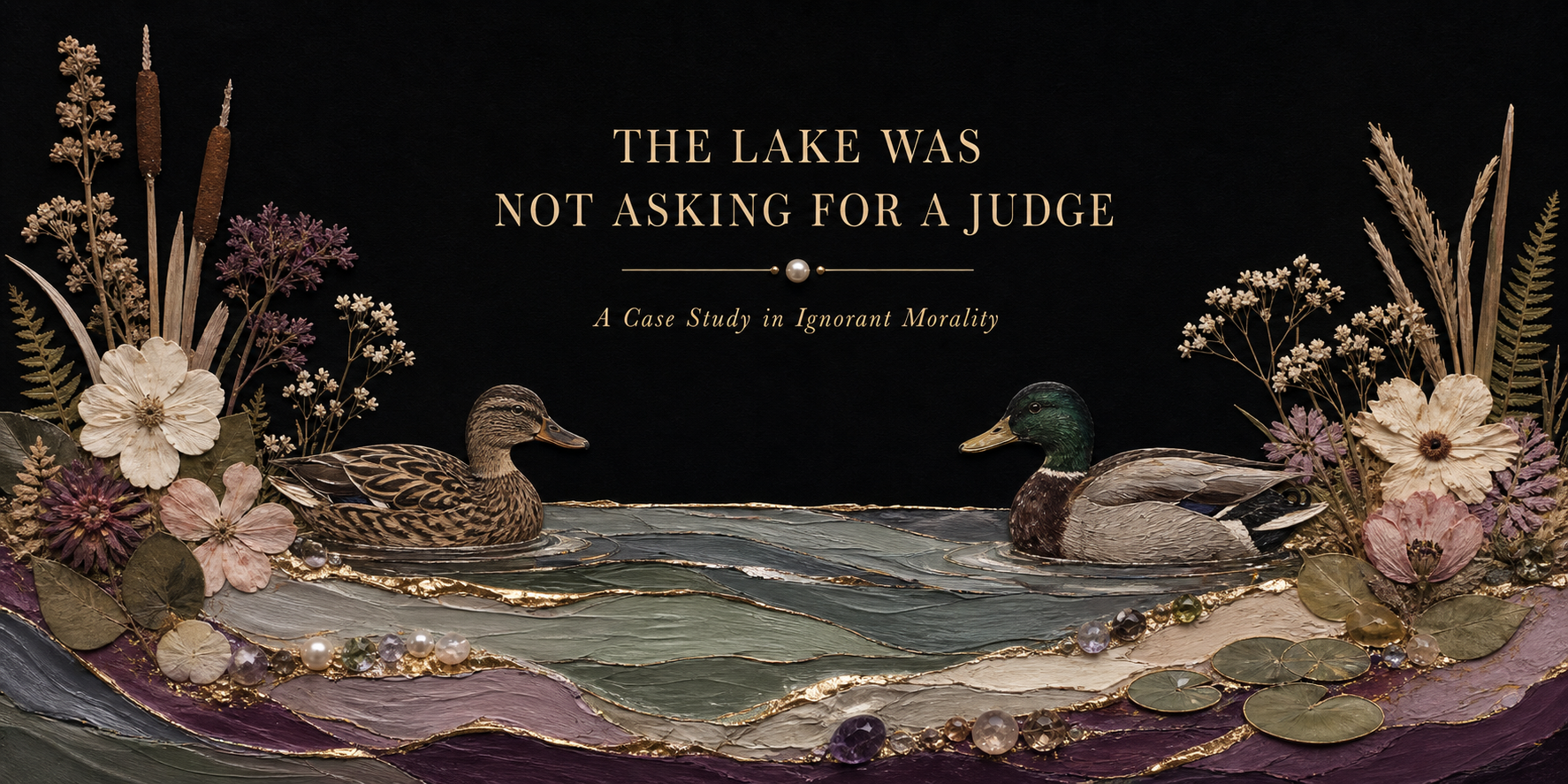
The Lake Was Not Asking for a Judge
One of the clearest examples of Ignorant Morality is something I once saw online: a woman screaming at a pair of ducks mating in the wild, trying to break them apart as if the moment belonged to her to define, interrupt, correct, or morally rearrange.
And yes, on the surface, it has the shape of internet nonsense. One of those moments where you almost want to close the tab, stare at the wall, and ask humanity if it needs a nap, a snack, or a supervised walk around the block. But the longer I sat with it, the less funny it became, because what I was watching was not only a woman misunderstanding ducks. I was watching someone enter a moment whose truth existed between two beings, then drag that truth away from them until the scene was no longer allowed to belong to the life actually living it.
That is the part that matters, because the harm was not simply that she disliked what she saw. The harm was that she moved the center of meaning away from the ducks and toward herself, as if the truth of the moment became more real once it passed through her reaction.
The issue was not only the screaming, or the panic, or the absurdity of a human looking at nature and deciding that because she did not like what she saw, something must have gone wrong. The deeper issue is that she did not understand where the truth of the moment was located. She treated the scene as if its meaning lived inside her reaction, when the truth of the scene existed between the ducks themselves, inside their own species, their own bodies, their own instincts, their own biological language, their own living relationship to one another.
She was not witnessing that relationship. She was replacing it, because she could not allow the moment to remain whole without becoming answerable to the human story she placed over it.
To the ducks, this was not a scandal. It was not a crime scene. It was not a confession of evil happening in broad daylight. It was not some symbolic reenactment of human violence asking for a human rescuer to arrive with a phone, a gasp, and a heroic misunderstanding. It was a biological process inside a reproductive system that was never designed to consult human discomfort before continuing itself.
But she did not pause long enough to ask what was actually happening between them, because pausing would have required her to admit that her first reaction was not automatically the truth of the system in front of her.
She saw a moment of life that had its own internal structure, its own meaning, its own context, and instead of letting that meaning remain with the beings who were living it, she pulled it through a human moral template and made it answerable to a story it did not belong to.
That is where Ignorant Morality begins, not in care, not in wisdom, not in reverence, and not in genuine protection, but in the moment we fail to recognize that a truth may exist outside of us, between beings, bodies, systems, species, processes, or relationships we have not taken the time to understand.
It begins when we see something unfamiliar, uncomfortable, rough, strange, or difficult to emotionally metabolize, and instead of pausing long enough to admit that we may not understand what we are looking at, we move the center of meaning toward ourselves. We stop asking what this is within its own structure, its own biology, its own world, its own relationship, and we begin asking what it feels like to us. Then, because the feeling is intense, because it arrives loudly, because it activates some internal alarm bell, we confuse intensity with accuracy.
And I want to be clear, because this is where people love to run off with the wrong little grocery bag: I am not saying humans are wrong for feeling something. Feelings happen. Discomfort happens. Shock happens. That first flinch is not the crime. The problem is what we do after the flinch. The problem is when we refuse to examine whether our feeling belongs to the system in front of us, or whether we have dragged an old story, a human wound, a cultural fear, or some half-formed moral script into a living moment and mistaken the collision for truth.
Because once that happens, we are no longer witnessing reality. We are witnessing ourselves projected onto reality, and then punishing reality for not matching the story we placed over it.
The lake was not asking for a judge. The ducks were not asking for a human interpreter. Nature was not standing there, waiting for someone to arrive with a panic response, a misplaced sense of authority, and the emotional confidence of someone who has mistaken personal disturbance for universal law.
But she entered the scene anyway, not as a student of what she was seeing, not as someone willing to understand the relationship unfolding in front of her, but as an editor. She took a moment that belonged between the ducks, pulled it away from them, renamed it according to her own discomfort, and then acted as if her misreading gave her the right to interfere.
That is not compassion, because compassion does not begin by removing a moment from the beings actually living it. Compassion does not drag a relationship out of its own structure, rename it through panic, and call that rescue.
That is projection wearing a little name tag that says concern, because the performance may look caring from the outside while the actual movement is possession: taking what belongs between other beings and making it answerable to the observer’s story.
And then there was the camera, which did not create the first misreading, but gave that misreading a body, a frame, a path, and an audience.
That matters, but not because the camera is the center of the harm. The camera is not the original violation. The original violation is the displacement of truth. The camera becomes dangerous because it takes that displacement and makes it public. It carries the misreading out of the living moment and into an audience, where the original relationship between the ducks becomes even easier to ignore because now everyone is gathered around the frame instead of the reality.
The phone comes out, the scene gets captured, the moment gets lifted out of its own context, and suddenly what existed between two beings is converted into something for spectators. The audience is invited to react to the human story placed over the moment, not to the truth of the living system itself. The ducks become less important than the interpretation. Their reality becomes background. Their bodies become evidence in someone else’s emotional argument.
This is where observation becomes dangerous, because the observer is no longer receiving reality with humility. They are beginning to move reality into a frame where their reaction becomes more important than the thing being witnessed.
Not because seeing is inherently harmful, but because seeing without humility can become a way of taking. It can take meaning away from the beings who are living it. It can take context away from the system that holds it. It can take a moment that belongs between two lives and drag it into the human theater, where the audience is encouraged to treat the observer’s reaction as the center of what happened.
At first, it almost looks like one strange person overreacting beside a lake. One human having a loud, misplaced moment. One woman acting like the ducks were personally violating her ethical code. But then you remember the camera is there, and suddenly the misunderstanding has been given legs. It is no longer only an interruption. It is a distribution. It is a public relocation of meaning.
We have normalized this everywhere, because the modern witness is often trained to capture before they comprehend, to publish before they perceive, and to turn another living moment into proof of their own reaction.
We no longer only misunderstand privately. We record our misunderstanding. We upload it. We invite reaction. We turn the world into evidence for whatever story our discomfort already wanted to tell. We see something, fail to understand it, and instead of letting that failure humble us, we make content out of it. We create an audience before we create comprehension.
And once there is an audience, the original thing being witnessed is no longer allowed to remain whole.
The lake becomes a stage. The ducks become characters. The camera becomes a witness with an agenda. The audience becomes a crowd gathered around someone else’s interpretation. Reality, somehow, becomes the defendant.
That is the violence of Ignorant Morality. It does not simply misread. It relocates truth away from the beings, bodies, or systems actually living it. It does not simply project. It organizes others around the projection. It does not simply misunderstand a living process. It degrades that process by forcing it to become answerable to a story it never consented to carry.
And once you see that pattern clearly, it stops staying beside the lake. It follows you everywhere.
We do this to animals, to strangers, to children, to grieving people, to disabled people, to unhoused people, to intoxicated people, to fat people, to neurodivergent people, to traumatized people, to angry people, quiet people, strange people, unfamiliar people, and anyone whose visible moment can be stripped of context and made useful to an audience.
Someone is crying in public, and suddenly the camera is out. Someone is having a crisis, and suddenly there is commentary. Someone is moving through a moment no stranger understands, and instead of asking what dignity requires, people ask whether the footage is interesting enough to share. We have created a culture where the phone often rises before discernment does, where people reach for the frame before they reach for the truth, where someone else’s vulnerable moment becomes material because the witness never stopped to ask whether the moment belonged to them to display.
And this is the part we keep pretending is neutral, because “just watching” sounds passive until the watching removes context, creates an audience, and teaches people how to misread what they are seeing.
We say the camera was just recording. We say the person was just watching. We say the audience was just reacting. But a camera is not neutral when it helps remove a moment from the life that gives it meaning. A camera is not innocent when it turns a living truth into a spectacle organized around someone else’s interpretation. A camera does not become a conscience simply because it captured what happened.
Sometimes the camera becomes the second violence, because it takes the first misreading and preserves it long enough for strangers to inherit it as if it were truth.
Sometimes the first violence is the misreading, and the second violence is the invitation for everyone else to misread with you, because now the distortion is no longer contained inside one observer. It has become a shared environment.
That is what happened at the lake. The ducks were not only interrupted by a human who misunderstood them; the truth between them was pulled out of their relationship and made available for strangers to judge. Their process was dragged out of its own structure and forced into a human story where it could be mocked, corrected, pitied, moralized, sensationalized, or turned into a little internet object for people to gather around.
And this is where witnessing becomes degradation, because the subject is no longer being seen in relationship to itself. It is being made available for consumption by people who were never accountable to its reality.
Because once a distorted witness creates an audience, the subject is no longer simply seen. It is displayed. It becomes available for reaction without relationship, judgment without understanding, performance without responsibility. The original reality gets buried beneath the social environment created around it, and the truth that belonged within the living system is treated as less important than what outsiders can make it mean.
This is the heart of Ignorant Morality: the belief that human interpretation is the highest authority in every room, every forest, every body, every species, every silence, every system, and every relationship between beings that may not resemble us.
It is the belief that our feelings are universal measurements, that our discomfort is proof of disorder, that our moral language can be thrown over any living process like a net, and that if something disturbs us, it must be violating something.
But sometimes the only thing being violated is accuracy, because the moment did not become violent when the ducks acted like ducks. It became violent when a human refused to let their reality remain their own.
Sometimes the harm is not in what nature is doing. Sometimes the harm begins when a human refuses to recognize that the truth of a moment may not belong to them, then turns that refusal into a public event.
She was protecting the story she had projected onto the ducks, not the ducks themselves. She was interrupting nature while calling it defense. She was responding to a humanized fiction she placed over reality, then punishing reality for failing to perform the role she assigned it.
And then she invited others to watch the punishment.
That is why this matters beyond one lake, one video, one strange little moment online. This is not about ducks as some isolated example of human weirdness. This is about the way humans repeatedly confuse access with authority. We see something and assume we are now entitled to define it. We observe something and assume we understand it. We watch something happen and assume the watching itself has given us permission to intervene, narrate, correct, expose, or display.
But looking is not understanding. Recording is not reverence. Feeling strongly is not the same thing as seeing clearly. Harm does not become harmless because it calls itself concern.
A misunderstanding with authority still interferes. A projection with a moral costume still distorts. A witness who cannot tell the difference between reality and their reaction to reality is not yet witnessing; they are colonizing the moment.
That is the part I keep coming back to, because this is not only about whether humans misunderstand what they see. It is about what we feel entitled to do once we have misunderstood it.
Ignorant Morality does not always arrive with cruelty in its mouth. Sometimes it arrives breathless and convinced it is helping. Sometimes it arrives with empathy language, moral urgency, spiritual vocabulary, academic confidence, public concern, or a phone already in its hand, framing the world before it has understood it. Sometimes it is so certain of its own goodness that it never considers the possibility that its goodness is the very thing making it dangerous.
Because when we do not understand a system, humility is the first ethical requirement, because without humility we cannot tell whether we are protecting something, interrupting something, exposing something, or simply dragging our own story into a place where it does not belong.
And humility matters here because ignorance is not empty. Ignorance still has weight. Ignorance still has hands. Ignorance still moves through the world and touches things. When we do not understand a system, we do not understand what our interference will interrupt, expose, distort, endanger, or erase. We do not know what role the moment plays inside a larger structure. We do not know what belongs to instinct, biology, survival, communication, grief, ritual, adaptation, protection, pain, or some pattern we have not yet learned how to read.
Humility is not decorative. It is not a nice little personality trait we pull out when we want to sound wise. Humility is the first restraint that keeps our ignorance from acting like authority. It is the pause that asks whether our reaction is actually a reliable witness, or whether it is carrying old fear, inherited bias, personal discomfort, cultural conditioning, or a story that belongs somewhere else.
Without humility, we do not simply misunderstand; we trespass into meanings, relationships, bodies, and systems that were never waiting for our interpretation to make them real.
We enter a living system through the wrong doorway and then behave as if our confusion is a key. We touch what we have not understood. We name what we have not studied. We interrupt what we have not located inside its own structure. We move the center of meaning away from the beings actually living the moment and toward the observer who happened to arrive with an opinion.
Humility asks us to slow down before we name what we are seeing. It asks us to learn the structure before we interfere with the structure. It asks us to recognize that not everything unfamiliar is asking to be corrected, not everything uncomfortable is asking to be stopped, and not everything we can see has become ours to explain.
Without that humility, witnessing turns into interference, because the observer starts acting before they understand what their action is touching.
Interference turns into spectacle when the action is recorded, framed, captioned, uploaded, and carried into an audience that has even less context than the original witness.
Spectacle turns into permission when the audience begins reacting to the frame instead of the reality, accepting the distortion as normal, funny, justified, educational, righteous, harmless, or deserved.
And permission, once normalized, becomes a culture of entitlement around what we do not understand, because repeated misreadings stop looking like violations when enough people learn to call them awareness, concern, humor, content, or common sense.
It becomes a culture where people feel entitled to record before they understand, expose before they protect, interpret before they learn, and correct before they have earned any relationship with what they are correcting. It becomes a culture where vulnerability is treated as content, discomfort is treated as evidence, public reaction replaces discernment, and the thing being witnessed is no longer allowed to remain whole because the crowd has already decided what role it is supposed to play.
It becomes a culture where misreading is not recognized as violence because everyone is too busy participating in it.
It becomes a culture where the act of seeing is mistaken for the right to possess meaning, where access becomes confused with authority, where visibility becomes confused with consent, and where a living process can be stripped of its own context because someone with a camera, a reaction, or a moral costume got there first.
That is how the lake becomes a stage. That is how the ducks become characters. That is how the truth between them becomes background. That is how the camera becomes a weapon. That is how the audience becomes permission. That is how reality becomes defendant.
And somewhere beneath all of that human noise, beneath the panic, the projection, the caption, the commentary, the performance of concern, and the little audience gathered around a scene they were never humble enough to understand, the truth of the system disappears beneath the story someone needed it to mean, because the original relationship was never allowed to remain the center.