How Am I Going To Make This Work? Get Out of My Way
Before Rosarium Strata, there was Belliaroze.
Survival shaped the road? Okay, and you know what? That is not the destination. And whatever your circumstances have tried to convince you of, they do not get the final word on who you are or what you are capable of building. You do not have to wait until your life is in order, your tools are master craftsmen 5000 premiere special, or wait until someone gives you permission. Begin with what you have and the rest can be built along the way.
I have to paint the thing, photograph the thing, scan the thing, and figure out why the hell it works, and try to do this with a budget of close to nil, extreme hardship, and children on my back. In truth, they were some of the worst conditions of my life while living in extreme poverty and having only the support of one person, my husband. The circumstances in my life did not create strength, they simply failed to take it from me, and the same can be said about you, about all of us.
I work with paint, photography, collage, texture design, Procreate, Photoshop, Wordpad (not kidding, not even a little bit), scanned brushstrokes, watercolor, acrylic, oil, paper, gouache, flowers, beads, lettuce, wood, sequins, hell I’ve even plucked bird feathers from the ground, you name it, I am working with it. You ever take a photograph of scrambled eggs because it reminds you of the perfect texture for the petal of a flower you’re painting and you’re scrambling (hehe) for time to finish it? I certainly have. I would paint individual elements by hand, photograph or scan them, clean them up, and rebuild them digitally, sometimes spending a large amount of time trying to make a library of digital surface. If I want texture, I have to go out and find it, and if I want a certain brush stroke, sometimes it takes at minimum 3 different clean brushes, a stick, and a butter knife per single stroke just to mix the color perfectly. Is this an arduous process? It is, and it is exactly what is required to get the authenticity of traditional art present in the digital world.
That process taught me how paint should move, how texture should gather and feel crunchy in my nose, how color creates the wrong feeling and entirely ruins it all, and how every part of a composition affects everything around it. I learned what makes an feel alive and beautiful to look at versus what makes something look beautiful but still feel uncanny.
The Material Workshop holds the non generative side of Rosarium Strata, the physical studies, digital paintings, photography, textures, collages, experiments, and finished works through which I built the language in the first place many moons ago, long before Rosarium Strata had a name.
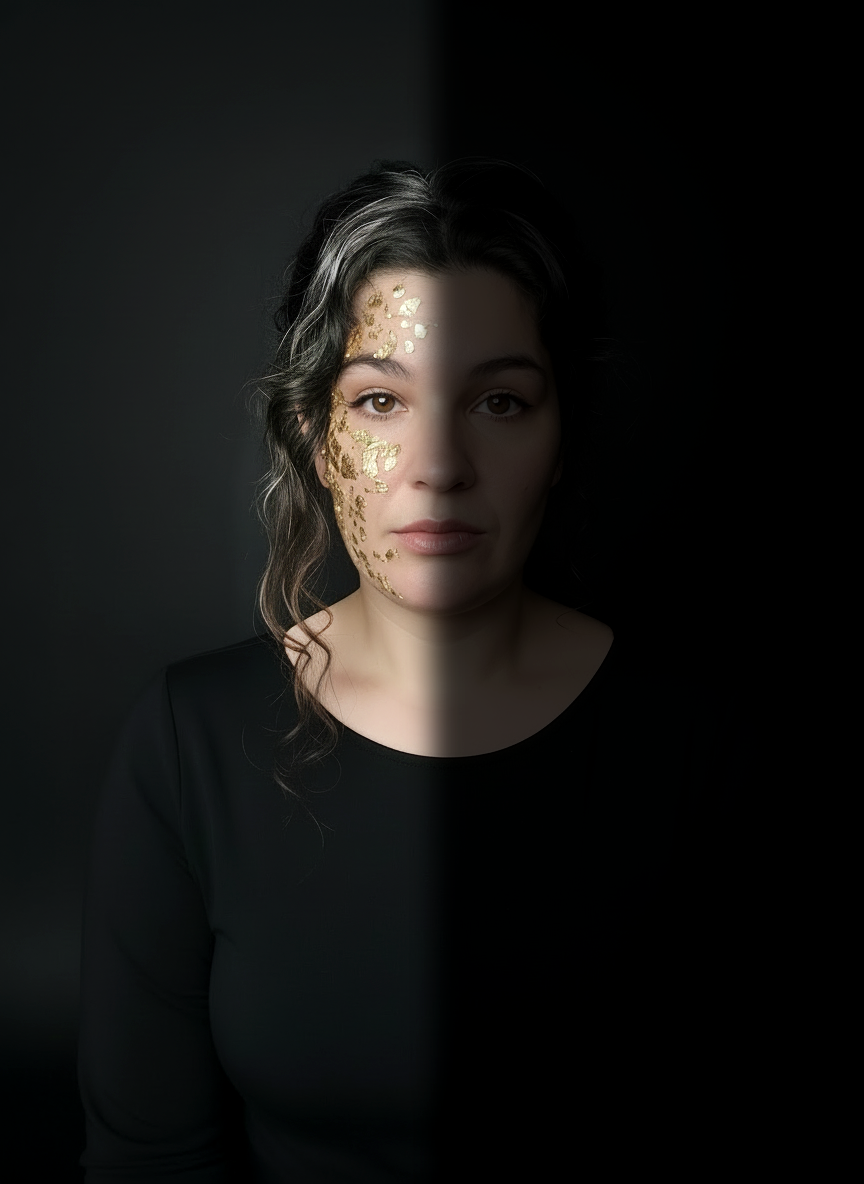
AI Disclosure 👽 The background was extended with Google Gemini because the existing gray roll didn’t reach the fucking floor, I didn’t want to crop it this time, and I just couldn’t leave it. My face is mine.
Rosarium Strata emerged from learning to recognize what materials were already telling me.
Well over a decade working in texture design and photography taught me that color is only one part of what gives a piece its feeling. A surface also communicates through pressure, movement, weight, interruption, reflection, and the physical evidence of how it was made. Paint gathers differently than paper. A gemstone anchors a composition differently than a flower. A color can deepen the emotional logic of a piece, soften it, or completely ruin the whole damn thing.
Rosarium Strata brings together my love of opulent texture, florals, and color. Each palette reveals the logic behind a finished piece and explores how everything can feel gloriously alive without losing its structure. I admit it also makes me want to chew on it with my eyeballs, if that is even a thing.
I wanted Rosarium Strata to become the language where I work out the logic and technical construction of each piece through what I already know materially. I know how paint moves beneath a brush or palette knife, how it gathers, folds, drags, resists, lifts, compresses, and catches the light. I know when a painted surface feels physically believable and when it has lost the plot. The work is not about inventing those behaviors from nothing. It is about finding a language capable of carrying the physical knowledge I have built through years of creating, including the things my hand understands before I have found the words for them.
The practice behind Rosarium Strata had been developing since 2013, although the instinct began much earlier. I was using Paint Shop Pro before I was even ten, followed by GIMP, Photoshop, Procreate, and nearly every other program I could get my hands on.
Long before generative artificial intelligence, I was already moving constantly between traditional and digital art. I used painting, collage, texture design, photography, illustration, physical material studies, and digital programs together because I wanted to preserve the evidence of the hand while expanding what a digital environment could hold. I was never interested in making the physical process disappear. I wanted to see how much of its movement, mess, irregularity, and material memory could survive the translation.
I was highly focused on trying to bring traditional materials into my digital work. I would paint individual lines, brushstrokes, watercolor marks, and textures by hand, photograph them, scan them with my Epson scanner, clean them up in Photoshop, and bring them into Procreate to use inside paintings that I was also building by hand. Sometimes I would make hundreds of marks just to find the right one. Then I would scan everything, cut it apart, adjust the color, layer it, and paint over it until every fragment felt as though it belonged inside the same image.
It was a very slow process of paint the thing, photograph the thing, scan the thing, edit the thing, and then use it to paint another thing. I was constantly moving back and forth between physical and digital tools because I wanted my digital paintings to retain the movement and texture of something made by hand. I did not want a brushstroke to become a generic digital suggestion of a brushstroke. I wanted the drag, the pressure, the uneven edge, the pooling pigment, and the evidence that something physical had actually happened.
In 2017, Belliaroze was born, and I went on to create textures for commercial use that preserved the authenticity of their hand painted origins. By then, I had already spent years building my own digital material library from hundreds of individual brushstrokes, painted marks, watercolor blooms, paper surfaces, found textures, photographs of nature, and fragments of physical media. I was learning how materials behave, how they carry movement, and how their physical structure can be translated into digital space without losing all evidence of how they were made.
I have always been fascinated by translation. A painted surface can become a digital texture, while a photograph can become a structural reference, yet neither one is necessarily the finished piece. Each process leaves information behind. Rosarium Strata became possible through learning how to recognize that information, carry it across formats, and build a coherent visual language from what remained.
That is also why the work is not only about producing a beautiful image. It is about understanding why the image works. I want to know whether a flower interrupts the movement of the paint or continues it, whether a stone anchors the composition or steals attention from it, whether the negative space breathes or simply sits there doing absolutely nothing. Every material changes the behavior of everything around it, and Rosarium Strata gives me a place to make those relationships visible.
Rosarium Strata is therefore both an artistic practice and an ongoing inquiry into what becomes possible when creativity is treated as communication between different materials, and nothing getting in your way of translating. It asks how an idea moves from instinct into language, from language into structure, and from structure into image through the visual logic inherited from traditional processes.
In other words, it is a language built to carry the memory of matter.